
WASHINGTON — Michael Brillon, a habitual offender convicted of felony domestic assault, had his convictions vacated and charges dismissed after it took six appointed lawyers and nearly three years to bring him to trial. Who is to blame for the violation of his speedy trial right — he and his many assigned lawyers, or the state?
The Vermont Supreme Court blamed the state and, with that ruling, ignited a fireball of criticism from domestic abuse groups, state and local governments and state prosecutors that has now arrived at the U.S. Supreme Court.
If the delay is because of assigned counsel's inaction or a breakdown in the public defender system, the state high court said, the system's failure to provide a speedy trial to a defendant who presses for it "is attributable to the prosecution, and not [the] defendant."
Vermont, backed by 39 states, the United States and major state and local government groups, now asks the U.S. Supreme Court to articulate a clear line — for speedy trial purposes — between public defenders and the government in criminal prosecutions. Vermont v. Brillon, No. 08-88.
Public defenders, like privately retained counsel, represent the interests of their clients, not the government, they argue. They are not state actors, and their actions should not be attributed to the government for purposes of the speedy trial clause of the Sixth Amendment.
"The Vermont Supreme Court moved this beyond the specific context of Michael Brillon and beyond the context of systemic underfunding of public defenders," said Utah Assistant Attorney General Ryan Tenney, amicus counsel to the states. "Yes, there is a question about what you do in these underfunded-system cases, but what concerned us was the pretty broad holding that a public defender is part of the state for speedy trial purposes. If that's true, that changes the way we have to do business."
Looking at the system
But the state high court found, and the trial record showed, that an "unacceptable amount of the delay" was not attributable to the defendant, but to the system, counters Brillon's counsel, William A. Nelson of Middlebury, Vt.
And, because the state bears primary responsibility for assuring speedy trials, pretrial delays caused by the state's failure to provide legal representation "should be counted on the state's clock," argues Nelson, just as other administrative failures are, such as court congestion, understaffed prosecution offices and negligence.
"The states have a legitimate concern about defendants gaming the system by challenging their lawyers and creating delays. It does happen, particularly in domestic violence cases which often rise or fall on the presence of the victim," said criminal law scholar and former public defender Brooks Holland of Gonzaga University School of Law. "But defendants not getting an adequate defense also happens, and it will only get worse in the next year or two if defense services are not on states' short list of budget priorities."
The Brillon case is one of eight criminal cases, out of a total of 11 cases, being heard by the justices in January. Besides the speedy trial question, they raise a variety of issues, from whether federally funded habeas counsel may represent a condemned inmate in state clemency proceedings when the state has denied state-funded counsel for that purpose to whether a defendant's voluntary statement, obtained in the absence of a knowing and voluntary waiver of the Sixth Amendment right to counsel, is admissible for impeachment purposes.
But the Brillon case may be the strangest in the group. Both sides agree that the state high court applied the correct legal test for a speedy trial violation: a four-factor weighing test under Barker v. Wingo, 407 U.S. 514 (1972). But each side is miles apart on who did what when and why after Brillon's arrest for striking his girlfriend in the face and violating a court order to stop harassing her.
Vermont's high court counsel, Christina Rainville of the Bennington County State's Attorney's Office, lays out a fact pattern in which the trial delays were caused "solely" by Brillon and his assigned attorneys, while the prosecution repeatedly objected to delays.
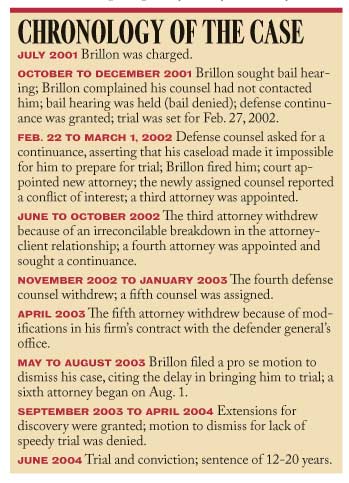
"Here, the defendant had six different assigned lawyers because he fired his first lawyer; his second lawyer withdrew due to a conflict; he fired his third lawyer (and also threatened him, forcing his withdrawal); he fired his fourth lawyer; and his fifth lawyer withdrew due to modifications in his contract with the Office of the Defender General.
"The fact is, were it not for Brillon's own conduct, this case would have been tried expeditiously. The prosecution was ready to go to trial within seven months of Brillon's arraignment."
(Vermont's Office of the Defender General may assign counsel to indigent defendants through state-employed public defenders, private lawyers engaged as "assigned counsel contractors," or "ad hoc" counsel assigned to individual cases.)
Calling Vermont's rendition "a false picture of this case," Nelson notes that the Vermont Supreme Court counted none of the time between the July 2001 arraignment and June 11, 2002, against the state's speedy trial clock. Nelson relies on the state high court's analysis of the record in his statement of what happened next:
"Defendant's fourth attorney, who was assigned in June 2002, stated at an August 2002 status conference that he needed an additional two months to prepare the case, and yet he apparently did little or nothing and finally conceded at a November 2002 status conference that his contract with the defender general (the state officer in charge of assigning counsel for indigent defendants) had expired and he was giving up criminal defense work.
"A fifth attorney was not formally assigned until January 2003, and he was allowed to withdraw four and one-half months later without having done anything because of a change in his contract with the defender general's office. At that point, the defendant had been incarcerated without a trial for approximately two years, and yet he was entirely without counsel for the next four months until the next assigned counsel took over in August 2003.
"Despite the already significant delay, the prosecution stipulated to several more continuances before a trial was finally held in June 2004," according to the court.
Incentives to delay
Vermont's Rainville contends that the Vermont Supreme Court ruling gives public defenders and court-appointed counsel incentives to delay cases in hopes that their clients may one day go free — with Brillon as a perfect example.She also argues that the ruling creates different classes of speedy trial rights for indigent and nonindigent defendants. Indigent defendants will have far greater speedy trial rights than those who retain private counsel. Delays caused by private counsel, she explained, do not get charged to the state because those lawyers are not employed by the state.
"Indigent defendants are far better off: Whatever happens, it is the state's fault," she said.
But indigent defendants also are disadvantaged by the ruling, she added. For example, the state and the trial courts are put in the "untenable position" of having to consider requests for continuances differently when the request is made by a public defender, because any continuance granted to a public defender will be charged as though it was the prosecution that requested it.
Utah's Tenney agreed, adding that prosecutors and defense attorneys currently can work together pretrial on the need for continuances.
"If it's true that a continuance request filed by a public defender counts against the state, then the state in virtually every case is going to oppose any request if it thinks there is any conceivable danger of a speedy trial problem down the road," he said.
But the Vermont Supreme Court ruling is not as novel as Vermont portrays it, insisted Brillon's counsel, Nelson, who is being assisted in the case by Jenner & Block appellate counsel.
"There are many other cases where courts have seen unacceptable delays in cases caused by absence of counsel or counsel just so backed up they can't provide representation in a real or substantial sense," he said.
The Vermont Supreme Court decision, he said, does not, as Vermont and its amici assert, convert public defenders into "government actors" and count their strategic delays against the state.
"The 'government actor' in this case is not the lawyer in his representational capacity, but the agency responsible for assigning counsel in its administrative capacity," he said. "Our brief is mainly directed at the statewide assignment-of- counsel system and, in particular, its assignment of counsel who are under contract with the defender's office."
A state-assigned attorney's decisions regarding scheduling generally bind the client, Nelson said. Nothing in the Vermont Supreme Court decision, he added, "augurs an absurd double standard for assigned and retained counsel regarding continuances."
The key delays here were caused by court congestion and negligence, combined with the absence of legal representation, he said. The overall delay was extended when the prosecutor, on notice about the lack of defense representation, took no action.
Nelson and others said it cannot be true that delay caused by the administration of a public defender system is the same as delay caused by private counsel for a defendant.
Given the underlying crime, the Brillon case, not surprisingly, also has attracted a strong amicus brief by nearly two dozen state and national domestic violence organizations.
Professor Cheryl Hanna of Vermont Law School, amicus counsel, tells the high court that, in domestic and sexual violence cases, there is a particularly high risk that defendants will manipulate the court system and attempt to further control and harass victims.
Her brief accuses the Vermont Supreme Court of failing to examine in detail the factual record, which, she argues, "contains overwhelming evidence that the delays during the first two years defendant was in custody were the result of defendant's own manipulation of the criminal justice system, including his desire to further 'trash the victim.' "
All of the problems raised by the case — inadequate public defender system, inefficient management of the trial process by the court and prosecution, manipulative domestic violence defendants — are very real problems and not just occurring in Vermont, said Gonzaga's Holland.
The question is whether the speedy trial clause, with its drastic remedy of dismissal of charges with prejudice, is the appropriate solution, he added.