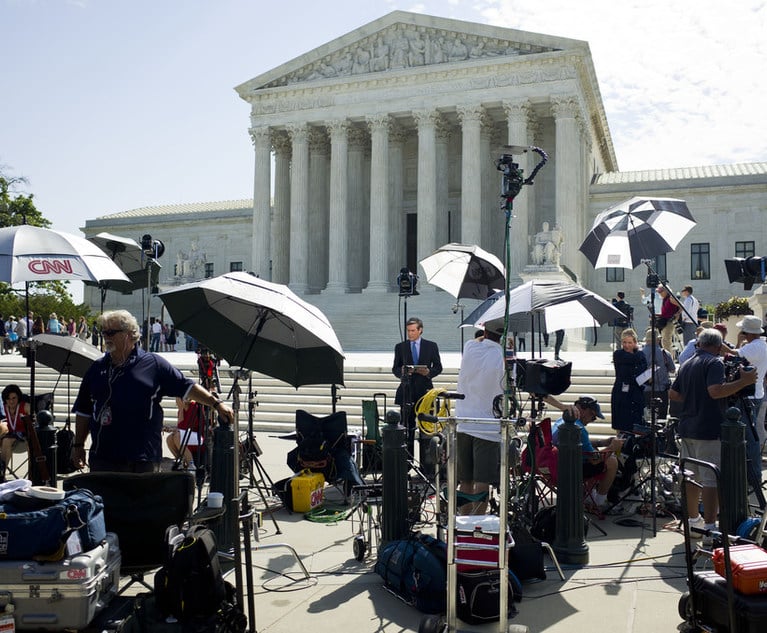
The United States Supreme Court
Photo: Stacey Cramp
For any attorney interested in oral advocacy, litigation and the U.S. Supreme Court, constructing a case for argument before the nation's highest court is the chance of a lifetime -- a chance that has become a reality for a group of third-year University of Pennsylvania Law School students.
One of them, Rachel Fendell, 25, of Short Hills, N.J., says she always wanted to be a lawyer. It was while working for the National Basketball Association in the Associate Program that she recognized that every business confronts legal matters, and she says her interest grew from there. She transferred to Penn after her first year of law school at Washington University in St. Louis, Mo., because she says she wanted to practice on the East Coast and take advantage of the opportunities at Penn -- but she never imagined she would be able to contribute to a Supreme Court case as a law student.
Another student, Bill Coglianese, 24, originally of Pittsburgh, says he feels he "lucked out" to be able to work on a Supreme Court case through Penn. Coglianese decided to attend Penn for law school over NYU and Northwestern, despite spending the least amount of time at Penn of any of the three schools he was considering. The draw, he says, was the collegiality of the Penn students and the great impression they made.
Fendell, Coglianese and six other students are participating in a semester-long clinic led by Penn professor Stephanos Bibas, which complements a seminar on the workings of the Supreme Court taught by professor Amy Wax and adjunct lecturer James Feldman.
The clinic came to be a part of the Penn Law program through the persistence of student Sripriya Narasimhan, 25, from Singapore. She asked Gary Clinton, dean of students at Penn Law, if he thought enough interest for the clinic could be generated.
"If Yale and Harvard have a clinic," she said, "why shouldn't we?"
The events that led to the formation of the clinic began last year, when a controversial decision by the Kentucky Supreme Court regarding immigration law was brought to Bibas' attention through Penn Law clinical supervisor and lecturer Yolanda Vazquez, who was writing a paper about the issue. Coincidentally, Bibas' former Yale Law School classmate, Stephen B. Kinnaird, an attorney with Washington, D.C.'s Paul Hastings Janofsky & Walker, also contacted him to ask if he wanted to help petition the Supreme Court to review the case. The approved petition provided the push needed to get the go-ahead to form the first clinic this year.
Bibas says he hesitated to take an active role in the case because of his busy schedule, but ultimately decided that it was "worth being busy to do this." Kinnaird and Bibas sought out the help of four dozen law professors and three interest groups to aid in the petition process.
The case, Padilla v. Commonwealth of Kentucky , involves non-citizen Jose Padilla, who has been living legally in the United States for 40 years. Following arrest in 2002 for a pair of marijuana possession misdemeanors and a marijuana trafficking felony, Padilla's defense lawyer, Quinn Pearl, told Padilla he would not risk deportation for entering a guilty plea to a drug charge, which was not the case.
Padilla now faces possible deportation following the completion of a 10-year prison sentence because of the said guilty plea. Bibas says Pearl faces no direct consequences, regardless of the decision of the Supreme Court. "Lawyers make mistakes -- there's no evidence of intentional misadvising," he said.
The clinic wrestled with various uncertainties regarding the scope of a lawyer's duties. "Is it the lawyer's duty not to misadvise?" Bibas asked. "Is it the lawyer's duty to inform the defendant of consequences even if he doesn't ask and especially if he does ask? Does a lawyer's role cover merely walking the defendant through the mechanics or making tactical decisions as well? It's worth considering, especially when life-altering repercussions are at stake."
Bibas, Kinnaird and the eight Penn students aimed to determine that an immigrant is entitled to an accurate answer. Kinnaird added, "The matter at hand is whether or not the misinformation is a constitutional violation."
The clinic afforded students the opportunity to aid Kinnaird in preparation for oral argument before the Supreme Court by posing questions for him in four different moot courts. They conducted research on the consequences of any immigrant, non-citizen or alien receiving an aggravated felony, in addition to focusing on discrete issues.
Kinnaird reflected upon the "great set of resources" Penn Law offered to strengthen his preparedness to stand before the justices, including the eight students and Bibas, who contributed his dynamic thinking, his court experience and his knowledge of criminal law, Kinnaird said.
"It was an amazing experience," said Fendell. "We all feel so fortunate because many litigators never get the chance, or even come close to getting the chance, to work on a case that will go before the Supreme Court." Of Kinnaird, she said, "He was so well-prepared -- he really grasped all of the main issues and peripheral issues."
Coglianese was equally as impressed with Kinnaird's skills as an orator: "There are definitely questions you don't want to get asked, but Kinnaird was forthright in acknowledging the weaknesses in his case, which is what any oral advocate should do. He had to explain some of the tougher facts." Bibas says he was also struck by watching how Kinnaird held his ground.
When the time for oral argument arrived in mid-October, the students who helped prep Kinnaird for the case got to see their work in action. In the courtroom itself, the students were observers. Bibas and the eight students listened as the different justices grappled with the various aspects of the case, mainly the question of with whom the responsibility to make a defendant aware of the consequences lays.
"We were watching and taking it in," said Coglianese. "It was a lot to keep up with."
For some students, it was their second time visiting the highest federal court because of the aforementioned Penn Law Supreme Court seminar, which some had taken the previous semester. But "it doesn't get old -- it's so exciting," said Fendell.
Coglianese remarked that it is "hard to imagine until you've been there -- I mean the nine justices have such a presence, and they're firing off questions from all different angles."
"It was fascinating to finally see the justices interact with lawyers because we have been reading their opinions for two-and-a-half years now. I like that I've been a part of something that will eventually become what law students read," said student Jonathan Ellis, 30, of Cary, N.C.
"Seeing our work in action is really exciting," agreed Fendell. "Through the clinic, the work has been so practical and hands-on."
Coglianese says he was captivated by the experience, but frustrated that the courtroom was so small -- he says the group had to take turns rotating in and out since there weren't enough seats for everyone.
While none of the students say they want to practice immigration law in the future, most are interested in litigation. Coglianese commented that he'd like to explore appellate litigation and Supreme Court litigation.
When asked what she learned from this experience, Fendell focused on the imperativeness of meticulous preparation: "I never could've imagined the detail, breadth and depth of research that's involved. We were taught to exhaust all options."
Coglianese echoed such sentiments, saying he learned to "dot every 'i' and cross every 't,'" and that he "developed an appreciation of the intricacies and planning required" of arguing before the Supreme Court. There was no follow-up project accompanying this experience for the students of the clinic -- just lunch at Paul Hastings, where the group discussed what had occurred in court.
"All of the work happens in preparation for the case," says Coglianese. "There is nothing left to be done now, except wait."
He is referring to waiting to hear of the court's ruling, which could be months away. Coglianese said the group tried to break it down by considering each of the nine justices and their respective leanings, but says he's "just not sure." Fendell says the clinic students are "crossing our fingers."
From working on a case where there's a real person's future on the line, Bibas says, the students have been able to take a "learn by doing" approach instead of merely writing about an abstract case.
"They have to write and rewrite and edit, and there's a big difference between reading the end result and shaping the end result," he said.
Bibas says his students learned the effective way to phrase something, in addition to realizing the difference between competent research and deep research. "I want to take my students from competent to excellent," he added.
Bibas also commented on another perk of the clinic: "By recognizing underserved populations through the efforts toward this case, the students are fulfilling their pro bono work requirement, in addition to the obvious educational benefit."
"It's been a great couple of months and Penn Law will certainly gain from this type of clinic," Coglianese said.
This article first appeared in Young Lawyer.