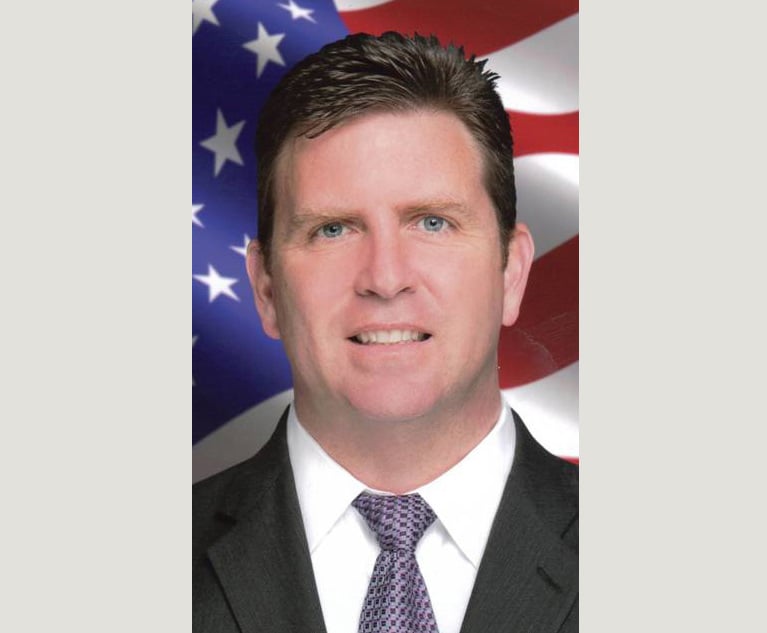
Mayer Brown partner Joseph P. Collins was kept out of the loop on hidden debt and sham transactions at Refco Inc. and should not be sitting in the defendant's chair, his attorney claimed Wednesday.
Launching a passionate defense of the man who prosecutors say helped conceal a $2.4 billion corporate fraud, William J. Schwartz of Cooley Godward Kronish said the three top Refco officials who defrauded banks and investors and ultimately destroyed the firm made a victim out of "an honest lawyer who believed he was representing an honest, trustworthy company."
The issue at the trial, said Schwartz, was "whether Joe Collins was on the inside or the outside - whether they kept him out of the loop, whether they kept him at arm's length, whether they lied to him so he could represent Refco" as an honest company.
The three principals were former chairman and chief executive officer Phillip Bennett, now serving 16 years for the fraud that landed the financial services company in bankruptcy, and two other men who have pleaded guilty in the case and are cooperating with the government by testifying against Collins: ex-finance chief Robert Trosten and former executive vice-president Santo Maggio.
Assistant U.S. Attorney Christopher L. Garcia told the jury in the courtroom of Judge Leonard B. Sand that Collins, 59, played a key role in helping Refco engage in "massive sham loan transactions" from 2000 through 2003 to hide hundreds of millions of dollars in debt in another entity, RGHI, a holding company partially owned by Bennett.
Garcia said the attorney also helped mislead banks in order to obtain revolving lines of credit in 2001 through 2003, by concealing the existence of various "round trip" loan transactions, in which Refco parked debt at RGHI during accounting reviews and later moved it back to Refco.
Garcia said Collins played a critical role in deceiving the Austrian bank BAWAG to provide a huge loan to the company in 2002.
And Collins helped prepare or directed the preparation of documents that were "full of lies" and presented to Thomas H. Lee Partners when the firm was preparing to buy 57 percent of Refco in August 2004, the prosecutor charged.
"Why? Why did this defendant lie for Refco?" Garcia asked. "Because it was his biggest client from 1997 through the collapse of Refco. This man made more than $40 million for his firm."
Schwartz ridiculed this alleged motive in his opening statement, repeatedly reminding the jury that "not one cent" of the fraud proceeds went to Collins, who worked out of Mayer Brown's Chicago and New York offices.
The $40 million was "less than 1 percent [of what Mayer Brown] made from all of its clients" during that time period, he said, and Collins earned the money from "legitimate, by-the-hour legal work," Schwartz said, so it was "absolutely ridiculous to say that's what his motive is."
Collins, he said, is a nationally respected lawyer with an excellent reputation who was devoted first to his family and second to the practice of law, a man who was well paid for his efforts.
"Why would he give it up? Why would he risk it all?" Schwartz said. "They don't have an answer, because he didn't, because he wouldn't have."
Schwartz promised the jurors that during a trial expected to last several weeks they would "see more lawyers than you've ever seen in your life."
He said lawyers "represent clients, they do not investigate clients," and they "are not accountants, they don't check the books of companies and they don't add up the figures and subtract the figures."
HIDDEN DEBT
Schwartz also said there were some differences among lawyers over how to view the debt transferred between Refco and RGHI, and the "critical distinction" in the case was between the "kind of debt that is hidden and the kind of debt that is disclosed."
Here, he said, Bennett and the two cooperators stuck massive amounts of debt "into a hole and pulled a rug over it," keeping it "hidden from Joe Collins."
The defense lawyer conceded that Collins did not disclose the debt situation to Thomas H. Lee Partners, but was merely refraining from disclosure out of a lawyer's obligation to be "discreet."
But Garcia said Collins and Bennett told Thomas H. Lee there was only $100 million in debt and, when Thomas H. Lee representatives said "get rid of it" as a condition of the sale, the two men agreed.
These were "complete lies," Garcia said, because both men knew there was $1 billion in debt.
Collins also kept some agreements with BAWAG "separate even from the lawyers at his own firm" and told lawyers with the bank "to deal only with him," Garcia said.
And not only was Thomas H. Lee "tricked" into buying the company on false pretenses, Garcia said, but the following year, in August 2005, Refco went public and "the public paid $500 million for a company that was in shambles."
Collins, who is on leave from Mayer Brown, joined the firm in 1994 and headed its derivatives group. He is charged in a superseding indictment with one count of conspiracy, two counts of securities fraud, two counts of making a false filing with the Securities and Exchange Commission, four counts of wire fraud and five counts of bank fraud.