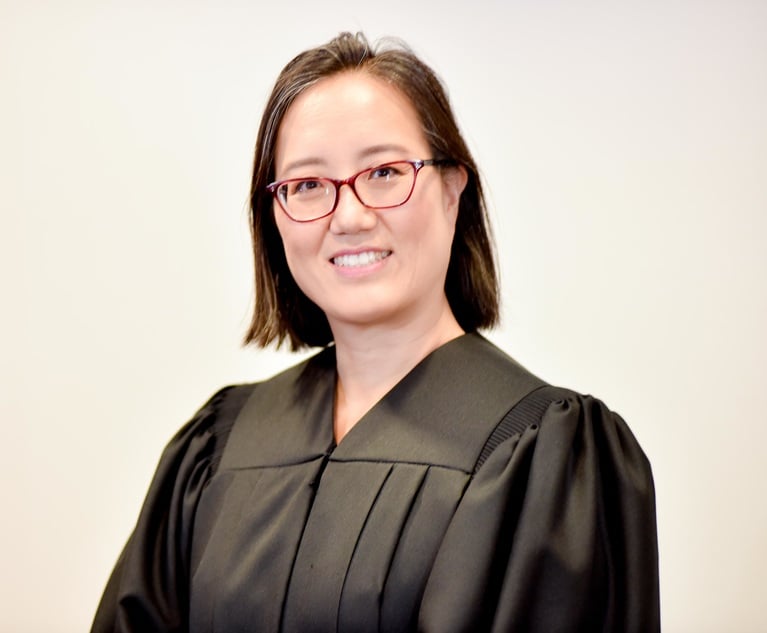
Fifth U.S. Circuit Court of Appeals Judge Fortunato "Pete" Benavides
Image: Angela Morris
Fifth U.S. Circuit Court of Appeals Judge Pete Benavides remembers that teachers at his elementary school couldn't pronounce his first name easily, so they nicknamed him "Pete" based on his middle name, Pedro. But considering what he calls his "fortuitous" career, Benavides notes that his real first name ended up being quite a coincidence.
"My name is Fortunato," he says.
Growing up in McAllen, Texas, influenced his judicial career. The second youngest of seven children, Benavides lived with his mother and his uncle. While much of McAllen's Hispanic community lived on the south side of town, one of the homes his uncle owned was located in the north, where not many Hispanics lived, Benavides explains.
Benavides says he never felt he completely belonged in either area, yet he appreciated both sides and got along with everyone.
"I think I was real lucky to grow up in an area where you're exposed to people in all walks of life and get a chance to meet them. Perhaps because of that you got a chance to empathize with them," Benavides says. He adds, "I think listening to both sides is something that is easy for me. I think that's perhaps why I like the law and I like the idea of fair resolution of disputes."
Benavides' uncle paid for him and his siblings to attend college.
"He would say, 'No one can steal your education, so get a good education. It belongs to you,'" Benavides says.
He took the advice and earned a bachelor's degree in business administration from the University of Houston in 1968. He says he wanted to be a lawyer since the eighth or ninth grade; he was impressed by a politician who was a lawyer and who used to visit his influential uncle during campaign seasons. His uncle was a respected community leader who ran a small church and owned a farm.
After earning his undergraduate degree, Benavides worked as a substitute teacher for one semester while he cared for his sick mother and uncle in McAllen. Then he entered law school and earned his law degree from the University of Houston Law Center in 1972.
For much of the 1970s, Benavides was a McAllen trial lawyer, representing clients in areas including business, education and insurance law. He was an associate with Rankin, Kern & Martinez from 1972 to 1974 and a partner in Cisneros, Brown & Benavides from 1974 to 1977.
He began his judicial career by accident. The Hidalgo County judge asked Benavides, who was the local bar association president, to help find someone to appoint to Hidalgo County Court-at-Law No. 2. When Benavides couldn't find a suitable candidate to suggest to the county judge, the county judge asked Benavides to accept the bench. Benavides initially said no, but after contemplating the move for several days, he changed his mind.
"Lo and behold, I enjoyed it," explains Benavides, noting he served from 1977 to 1979. Following a short stint as a McAllen solo, he won election in 1980 to his second bench, the 92nd District Court in Hidalgo County, where he served from 1981 to 1984.
Then-Gov. Mark White appointed Benavides to fill a vacancy on the 13th Court of Appeals in Corpus Christi, where he served from 1984 to 1991. He reached the next rung on the ladder in 1991, when then-Gov. Ann Richards appointed him to a vacancy on the Texas Court of Criminal Appeals. But he lost his seat in the 1992 election.
Benavides served as a visiting judge in 1993, and he was a partner in Atlas & Hall in McAllen from 1993 to 1994.
In 1994, then-President Bill Clinton nominated Benavides to fill a vacancy on the 5th Circuit, and the U.S. Senate confirmed him later that year.
Benavides' uncle and mother were very proud he earned his law degree. His uncle died shortly after Benavides graduated, and his mother passed away after he became judge of Court-at-Law No. 2.
When asked what his mom and uncle would think if they saw him on the 5th Circuit, Benavides replies, "They'd probably be wearing buttons with my picture on it."
Texas Lawyer reporter Angela Morris emailed Benavides some questions about his years as a judge on the 5th Circuit. Here are his answers, edited for length and style.
Judge Pete Benavides
5th U.S. Circuit Court of Appeals
Appointed to the 5th Circuit: 1994
Age: 64
Texas Lawyer: After being a judge, if you were to become a practicing attorney again, what would you change about your work habits?
Judge Pete Benavides: I don't know, but I am sure I would not have everyone stand when I walk into the courtroom.
TL: What would be your warnings for your prospective replacement?
Benavides: Do not hire ideologues. Hire the best and the brightest, and make sure they are good people that get along well with others.
TL: What advice would you give lawyers just starting out in their careers?
Benavides: Listen before speaking; try to be the last to speak, not the first; be more prepared than anyone else in the courtroom; be honest and forthright with your client and the court.
TL: What are the most effective techniques you've seen from attorneys with cases before the 5th Circuit?
Benavides: The ability to make complicated matters simple and to make their positions clear, reasonable and supported by law.
TL: What habits or behaviors should lawyers avoid while practicing before the 5th Circuit?
Benavides: Avoid seeming preachy and overbearing; avoid hyperbole; don't bicker with adversaries or the judges; and avoid petty or inconsequential arguments.
TL: What are the toughest cases over which you have presided and why?
Benavides: Cases that involve important issues that are poorly briefed. Good lawyers and good briefs make good law by making it easier to come to an informed decision.
TL: What is something about being a federal appellate judge that most lawyers don't know or that they perceive inaccurately?
Benavides: We like football and baseball and get along well despite having strong disagreements as to the law in some cases.
TL: Do you believe a rapport with other judges is important?
Benavides: Yes, but respect is more important. The judges on our court are all smart people (being average doesn't get you Senate confirmation), but respect for others and their views is essential to a well-functioning, collegial court.
Watch a video of Judge Pete Benavides here.