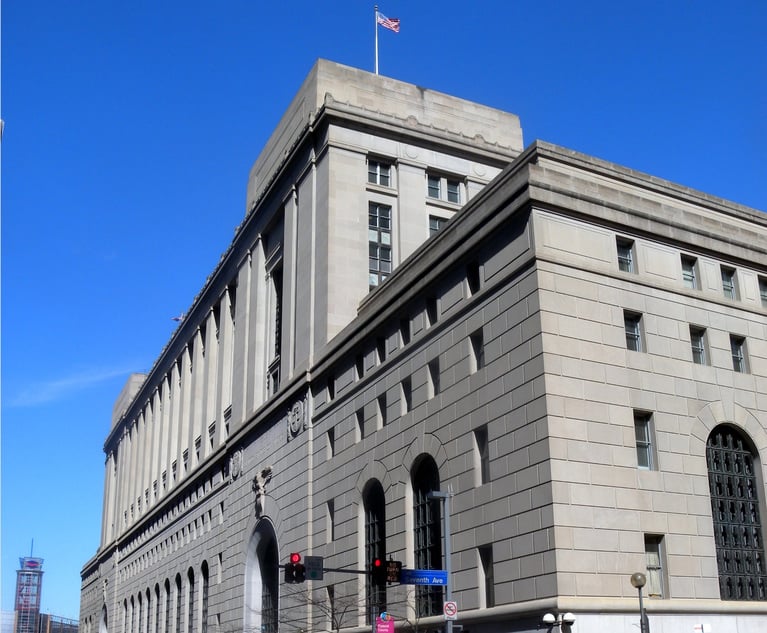
Southern District of New York Judge Jed S. Rakoff grilled attorneys for the Securities and Exchange Commission Monday about a proposed $150 million settlement -- the second submitted to him -- that would bring an end to two actions against the Bank of America Corp. stemming from its $50 billion takeover of Merrill Lynch & Co. in 2008.
The actions accuse the bank of failing to disclose to shareholders that it had authorized Merrill to pay up to $5.8 billion in bonuses in 2008 and of keeping shareholders in the dark about "extraordinary" losses Merrill sustained in the two months before the merger.
Last year, Rakoff rejected a $33 million settlement over the bonus pay, which he called a "contrivance" and criticized the settlement for making shareholders pay an "additional penalty for their own victimization". The action, Securities and Exchange Commission v. Bank of America Corp., 09 Civ. 6829, is scheduled to go to trial on March 1.
Monday's hearing covered that lawsuit and a second proceeding filed by the SEC last month, Securities and Exchange Commission v. Bank of America Corp., 10 civ. 0215.
Rakoff observed that the $150 million fine included in the settlement, while still small, was "more meaningful" than the earlier proposal. He expressed some reservations about remedial measures in the settlement but said they were "quite positive" overall.
However, he asked for more information about the role of the attorneys who advised the bank bearing on the question of whether it was culpable or simply negligent.
Rakoff said he would make a decision by Feb. 19.
The 1 1/2-hour session came on the heels of a suit filed by Attorney General Andrew M. Cuomo accusing the bank and former chief executive officer Kenneth D. Lewis and then-chief financial officer Joseph L. Price of deceiving the federal government by making an "empty threat" to pull out of the merger unless the government ponied up bailout money.
The government gave the bank $20 billion in bailout funds in January 2009, which the bank repaid in December along with $25 billion it had received earlier.
Under the terms of the most recent proposed settlement, the bank would have to pay a $150 million fine and implement seven remedial measures for three years, including retaining "disclosure counsel" to advise the audit committee of Bank of America's board and giving shareholders a nonbinding say on executive compensation. (See Bank of America's and the SEC's memoranda of law in support of the proposed consent judgement.)
The pact also includes a 35-page statement of facts prepared by the SEC, which says that the Bank of America's agreement with Merrill over employee bonuses "was not publicly disclosed" to shareholders before they approved the merger on Dec. 5, 2008, and states that the bank did not reveal that Merrill had lost $15.3 billion in the forth quarter of 2008 until more than one month after the shareholder vote.
While the bank has acknowledged there is an "evidentiary basis" for the statement of facts, it insists that it does not represent the "complete record" or amount to an admission of liability.
'STRIKING DIFFERENCES'
Rakoff focused on what he called the "striking" differences between the SEC's factual statement and the facts presented in Cuomo's complaint.
In particular, the judge asked George S. Canellos, the director of the SEC's New York regional office, why the agency was "silent" about the circumstances surrounding the termination of the bank's former in-house counsel, Timothy Mayopoulos.
According to the attorney general's complaint, the bank fired Mayopoulos on Dec. 10, 2008, one day after he claimed he learned Merrill's losses stood at $9 billion rather than $7 billion.
According to Cuomo's complaint, Mayopoulos was terminated "without warning" and replaced with Brian Moynihan, an attorney who had not practiced law for roughly 15 years. Moynihan has since replaced Lewis as the bank's CEO.
Rakoff said this issue was important in determining whether the bank's failure to disclose Merrill's losses to shareholders was the result of negligence or culpable intent.
Canellos assured the judge that the SEC's view was that the bank did not "conceal any information" from its attorneys.
He called the timing of Mayopoulos' firing a "coincidence," and suggested that, contrary to Cuomo's allegations, the former general counsel might have been aware of the $9 billion in losses before Dec. 9, 2008.
Canellos said Mayopoulos was terminated after the bank learned that Moynihan planned to leave in the midst of the merger. To retain Moynihan, the bank offered him the position of general counsel.
However, a skeptical Rakoff persisted in questioning the SEC's version of the facts, asking why the bank had pushed Mayopoulos out the door without giving him an explanation.
The judge also asked Canellos whether the SEC agreed with Cuomo about the role the bank's outside counsel, Wachtell, Lipton, Rosen & Katz, had played in advising the bank about its disclosure obligations.
Cuomo's complaint alleged that Wachtell had recommended further disclosure in November 2008 and discussed how it would be achieved.
"Shortly thereafter ... the decision was reversed, Wachtell's role was marginalized, and the Bank made its own decision not to disclose," the complaint states. "Outside counsel was never again consulted about disclosure, even after the losses later doubled."
Canellos agreed that the bank consulted Wachtell at an "early stage," and did not solicit follow-up advice.
"Where I think this cuts ... is I am really presented here with two strikingly different version of the facts," Rakoff said, adding that he would like to see portions of the records dealing with Mayopoulos' firing and Wachtell's "limited" role.
He said he would issue an order by Thursday detailing exactly what material he was seeking.
Turning to the substantive terms of the proposed settlement agreement, Rakoff said the remedial measures on a whole "strike me as quite positive." However, he raised several concerns about certain terms of the provisions, including the Bank of America's power to select a "disclosure counsel" and questioned whether the court should play a more hands-on role in selecting a "compensation consultant."
And while he said the $150 million fine was "still quite small in view of the huge sums involved," it was "at least more meaningful than the $33 million originally proposed."
But the judge said the settlement "still suffered from a fundamental flaw" by taking money from shareholders who had been harmed and recirculating it back to them.
"If the individuals aren't going to be penalized, isn't the money effectively coming from shareholders?" he asked.
Lewis J. Liman of Cleary Gottlieb Steen & Hamilton argued on behalf of Bank of America.