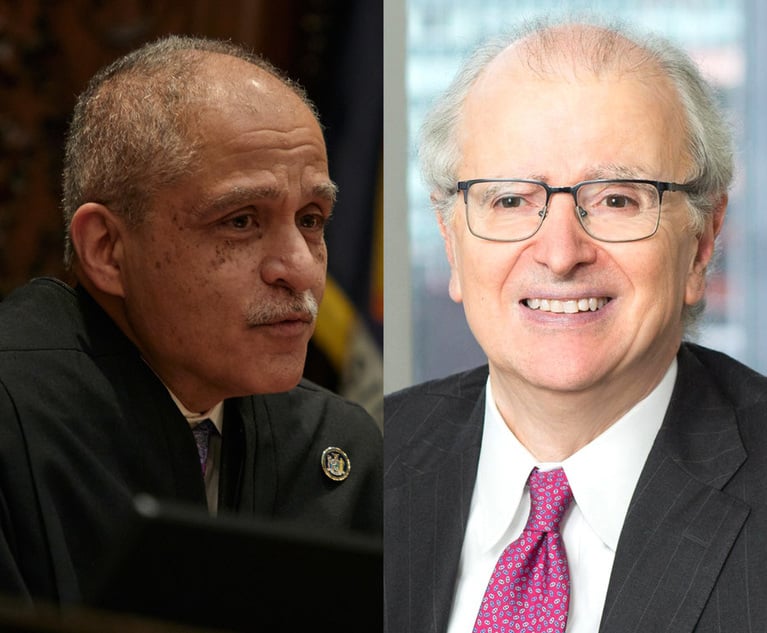
Gibson Dunn's Theodore Olson
photo: Patrice Gilbert/Legal Times
Most Januarys, Gibson, Dunn & Crutcher partner Theodore Olson gives the firm's freshest hires a speech that he calls "How to Fail." One sure way, he tells them, is always to swim with the current. "Sheep, lemmings and dead fish all learn to head in the same direction at the same time," he warned in a recent version of his talk. The message is clear: Don't be afraid to think for yourself and make your own path.
His bromide has become a market strategy and a hallmark for the firm's practice. Time and again in 2008-09, blue-chip clients in desperate straits have turned to Gibson Dunn lawyers to get them out of trouble at every stage, from subpoena to summary judgment to U.S. Supreme Court final appeal. The litany is breathtaking: helping Dole Food Company, Inc., end a costly war of attrition with Nicaraguan plaintiffs, and uncovering a nasty pattern of fraud in the process; beating back massive, reputation-gutting employment class actions for Wal-Mart Stores, Inc., and United Parcel Service, Inc.; persuading the Supreme Court, on behalf of a teetering West Virginia mine owner, that a state judge must recuse himself if he took money from one of the parties in his last campaign -- a now obvious point that was in the couldn't-be-done category two years ago. "I call them lifeboat lawyers, because our careers depend on them," says Wal-Mart executive vice president and former general counsel Thomas Mars. For those rescues, and a broader record of excellent work for hard-pressed clients, The American Lawyer names the firm its Litigation Department of the Year.
The department has marquee partners, a very deep bench and a guiding sense of creative calm in the face of crisis that helps make it greater than the sum of its parts. "We are the firm that clients in distress have turned to when they are facing their worst problems, or when they have in fact faced defeat," says litigation department co-chair Randy Mastro. "And we have been the problem solvers, the game changers." In case after case, Gibson Dunn litigators stepped in when clients needed not just a law firm, but a rescue squad.
The coup that Gibson, Dunn pulled off for Dole may have been its most striking rescue yet. In 2007 plaintiffs lawyers convinced a California jury that the company's pesticide use decades earlier had left Nicaraguan banana farmers sterile. Facing thousands of similar claims from Nicaragua and other countries, Dole general counsel C. Michael Carter replaced his Jones Day lawyers with Gibson Dunn partners Theodore Boutrous Jr., Scott Edelman and Andrea Neuman. They, along with Carter, were convinced that the plaintiffs' claims were manufactured. Instead of playing defense, Gibson Dunn attacked.
"We had this strategy to try to break this thing wide open," says Boutrous. "That was our suggestion: Let's go after this, let's expose this for what we think it is."
The fraud that Gibson, Dunn uncovered in 2009 was massive: a conspiracy by the plaintiffs -- and their lawyers -- to extort huge sums of money based on claims by Nicaraguans who were not sterile and had not even worked on Dole plantations ["The Kill Step," October 2009]. Neuman coaxed one plaintiff to admit that he had been trained to testify "like a parrot," and she found others so frightened of retribution for testifying that they nearly collapsed during depositions. Just months after taking over, the Gibson Dunn team convinced California superior court judge Victoria Chaney to dismiss the two leading cases after a three-day evidentiary hearing. "The Gibson lawyers knew how to step back and deal with the whole environment," says Carter. "Their perspective was, 'Someone is trying to rip the company off: What do we do about that?' "
Gibson Dunn's win for Dole in California continues to reverberate. A federal district court judge in Miami has since refused to enforce a $98 million Nicaraguan judgment against Dole and The Dow Chemical Co. based on evidence of corruption that the firm presented. In November the Gibson Dunn team won dismissal of seven remaining pesticide cases brought against Dole by Ivory Coast plaintiffs after claims of fraud surfaced there. And other companies facing international toxic torts claims have taken notice: In October, Chevron Corp. hired Gibson Dunn to help defend it in its long-running battle over oil pollution in the Lago Agrio region of Ecuador. Given the apparent evidence of fraud and corruption that has surfaced in the Lago Agrio litigation, "it was a natural fit for us to talk about it with Chevron," says Boutrous. (He says that he's also advised other companies in similar cases, but declined to identify them.)
Dole wasn't the only client congratulating itself for making a switch to Gibson Dunn. When shareholders sued The Williams Companies, Inc., in a $3 billion securities class action after a subsidiary went bankrupt, general counsel James Bender, a onetime Gibson Dunn associate, initially turned to Skadden, Arps, Slate, Meagher & Flom, but became frustrated by what seemed like dithering by the Skadden lawyers. "There was a lot of hand-wringing about actually getting things done," says Bender, who decided to look to his old firm for replacements. Gibson Dunn partners Timothy Roake and Wayne Smith got the case dismissed in federal district court in Tulsa. Then they won on appeal to the 10th U.S. Circuit Court of Appeals, which tightened the standards that plaintiffs must meet to prove loss causation in federal securities cases. (Skadden declined to comment on its role in the case.)
Gibson Dunn has also been a top choice for law firms in need of their own rescue, particularly in malpractice litigation. The firm keeps most law firm clients out of the spotlight, but in at least one instance Gibson Dunn was called in when avoiding publicity was a lost hope. After Tae Bo creator Billy Banks won a $30 million malpractice verdict against Seyfarth Shaw in 2005, Seyfarth hired Gibson Dunn partners Kevin Rosen and Daniel Kolkey to lead its appeal. In February 2009 a California state appeals court threw out the jury verdict and remanded the case. Seyfarth is keeping the Gibson Dunn team in the lead for the new trial.
Subscribe to The American Lawyer