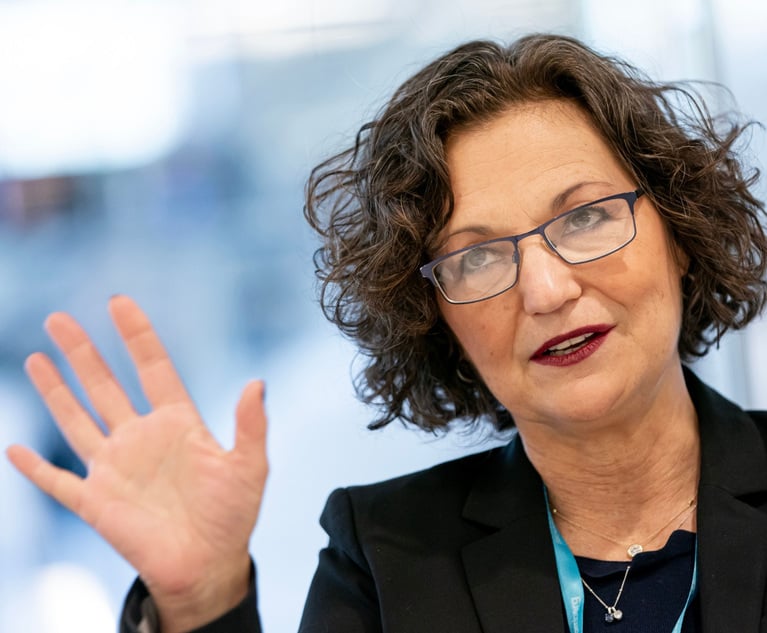
Karen Johnson-McKewan has been wearing her Levi's a lot lately, and her colleagues at Orrick, Herrington & Sutcliffe don't mind at all.
Earlier this year, Johnson-McKewan inked a deal with client Levi Strauss & Co. that is Orrick's broadest alternative fee arrangement ever.
Orrick will handle all of Levi Strauss' legal work worldwide in exchange for a fixed yearly fee paid in monthly increments. Levi Strauss will keep only one other firm, Townsend and Townsend and Crew, to continue its brand protection work. Where Orrick doesn't have an office, the law firm itself will retain and pay outside counsel.
Johnson-McKewan worked closely over the last year with Levi Strauss general counsel Hilary Krane to iron out the details of the multimillion-dollar arrangement. They agreed to a contract in May. Already, 116 Orrick timekeepers in seven countries have worked on matters for the San Francisco-based apparel maker. Now, as Levi Strauss prepares to enter its new fiscal year on Nov. 30, the Orrick partner says they're driving together into new territory.
"The only way to make it work is to be open and flexible with the issues as they come up," Johnson-McKewan said. "The core principle that we're operating with here is that we're trusting each other. We all are committed to doing whatever we can to make it work. We know there will be bits and pieces where it may not."
Alternative fee billing has been a buzzword for decades, but many say this recession has finally given the trend some teeth.
Most firms, of course, want to give the clients what they want. The trick is figuring out what to charge. At Orrick, those calculations are being done by David Fries, a nonpracticing lawyer and a member of Orrick's management team.
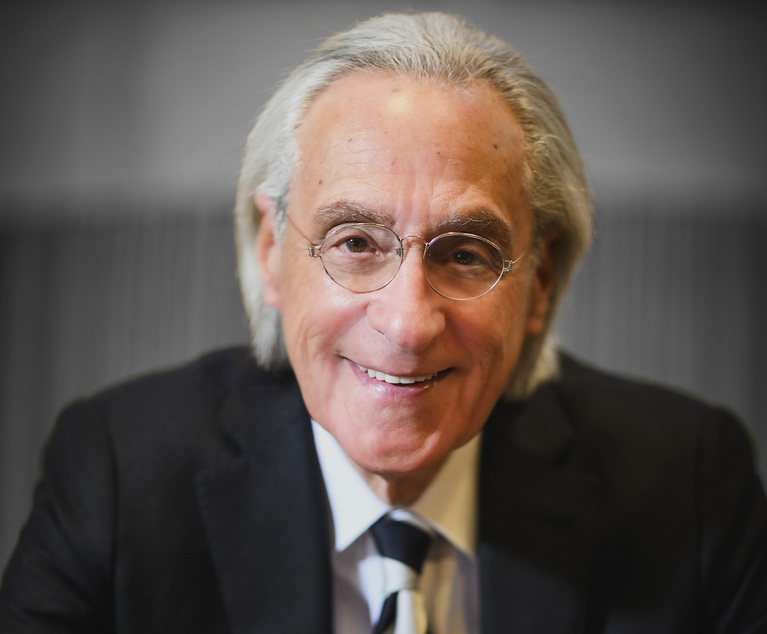
Fries, who'd been a partner in the 1990s, rejoined the firm as a consultant in late 2006. Earlier this year, the firm made him its full-time chief client relations officer, with a large portion of his time spent advising partners on alternative billing.
"We looked at applying the most basic client relationship management practices of other industries to the law firm," Fries said. Prior to 2006, he was an executive at a public company that decided to orient itself more to understanding its customers' "points of pain," a concept he brought to Orrick.
"Very rarely do lawyers ask their clients, 'What is the approach you want me to take? Here are two options: I can treat this like it's the most important case in the world, put 10 people on it and it will cost X. Or I can do it differently,'" Fries said. "It's understanding the objective of the clients, and that involves deep dialogue. This is something customers and suppliers do in the rest of the business world."
Fries, who works mainly out of Minneapolis, as well as New York and San Francisco, sees at least a dozen alternative fee proposals pass across his desk each day.
"Virtually every type of transactional work, we are able to do with some type of fixed-fee," he says. "We have a limited number of extremely broad, all-encompassing relationships."
Practice leaders approve the deals, often after partners discuss them with him. He also meets directly with clients about possibilities.
On the Levi Strauss deal, Johnson-McKewan negotiated with the client, but Fries was her "prime adviser," she said, providing a lot of support, analysis and good counseling.
Orrick declined to disclose how much Levi Strauss would pay it, or how much it expects to save the company.
TRUST BUILDS TRUST
Mark Chandler, the general counsel at Cisco Systems Inc., has been a vocal proponent of exploring ways to increase law firm efficiency.
"One interesting phenomenon when we started asking for bids for fixed fees: The lowest bids we got were from firms that worked with us before and knew us and had a trust relationship -- they knew that my policy was to protect the firms' profitability," Chandler said. "If something unexpected came up, I would make sure they were covered. I'm interested in efficiency of operations."
Alternative fee arrangements take a little more time to negotiate, and involve building a different kind of relationship with a client, he said.