A trial over whether Graubard Miller is entitled to a $42 million contingency fee from the estate of the widow of a real estate tycoon is set to begin today in Manhattan.
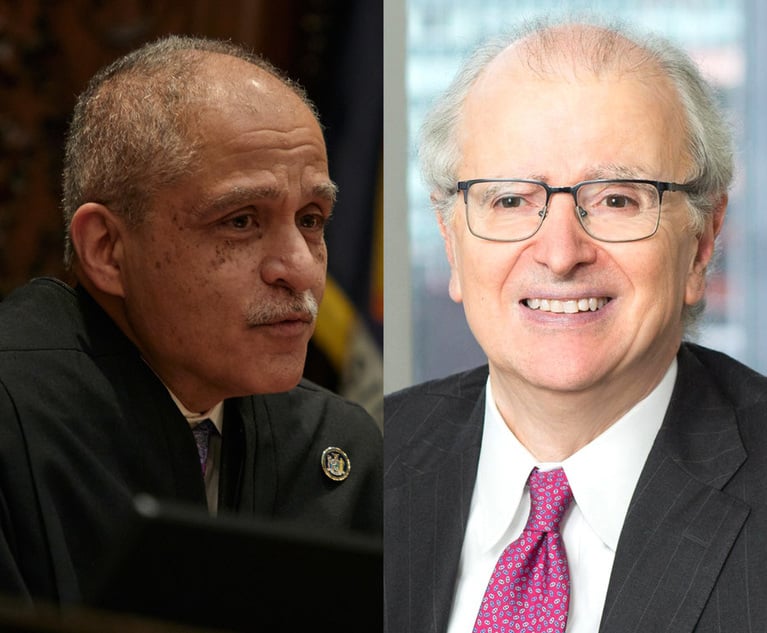
The trial, before Howard Levine, the former New York Court of Appeals judge serving as referee for Acting Manhattan Surrogate Troy Webber, will be the latest phase of a four-year litigation between the firm and its former longtime client, Alice Lawrence.
Lawrence refused to pay Graubard attorneys what her estate called an "unconscionable" $42 million after the firm in 2005 won a $104.8 million settlement just four months after agreeing to switch to a contingency fee after two decades of billing hourly rates.
Lawrence died in February 2008. Levine last month said in a referee's report that evidence presented by both sides raised material questions as to the value of Graubard's services and whether medical problems suffered by Lawrence interfered with her ability to understand the agreement she was signing. (Read the referee's report (pdf).)
"The suggestion that she did not know what she was doing or that the firm took advantage of her has no basis in fact and we're confident the proof will demonstrate that," said Mark Zauderer, a lawyer for Graubard Miller at Flemming Zulack Williamson Zauderer.
Also at issue is whether the fee contract is valid in light of $7.75 million in gifts and gift taxes Lawrence claims Graubard lawyers solicited from her.
For its part, Graubard is seeking sanctions against the estate for concealing the condition of Lawrence's health when the firm tried to depose her.
LONG-TERM CLIENT
Graubard Miller represented Lawrence for 22 years in litigation over the estate of her husband, Sylvan Lawrence, the co-owner of a multimillion dollar real estate empire in New York. Lawrence's will named his brother and business partner, Seymour Cohn, as his executor.
Lawrence, who did not want to be in the real estate business, turned to Graubard to force Cohn to liquidate the estate. After years of litigation, more than $350 million in distributions were made to Lawrence and her children.
By 2004, with the last property, 95 Wall St., in dispute, the estate said Lawrence became concerned about the size of her legal bills. She had paid more than $18 million to Graubard over the years and fees by then approached $1 million a quarter.
The firm and Lawrence entered into a new agreement. For the first year, it would receive at most $300,000 a quarter. It also stood to earn a 40 percent contingency on any recovery. The firm contends it had expected the case to go on for several years. But instead it settled unexpectedly within four months when new evidence came to light.
The litigation over 95 Wall settled for $104.8 million. Lawrence refused to pay Graubard the $42 million and brought in a new lawyer, Leslie Corwin at Greenberg Traurig, who argued the fee case at trial and at the Appellate Division, 1st Department.
Corwin has since been replaced by Daniel Kornstein of Kornstein, Veisz, Wexler & Pollard.
In November 2007, the 1st Department, ruled 4-1 in Lawrence v. Graubard Miller, 48 AD 3d 1, that the fee arrangement was not unconscionable on its face, though its size might "arguably seem excessive and invite skepticism."
In dissent, Justice James A. Catterson called the fee "exorbitant" and said the matter should be referred to the Departmental Disciplinary Committee.
In December 2008, the New York Court of Appeals in Lawrence v. Graubard Miller, 11 NY 3d 588, unanimously found that more information was needed to determine if Graubard's fee is unconscionable. Judge Theodore T. Jones Jr. ruled that while "on its face" the fee's amount "seems disproportionate" to the work the firm did, "we have not been presented with facts to refute or support this hypothesis, or to evaluate the agreement's unconscionability."
MILLION-DOLLAR GIFTS
Among those set to testify at the trial beginning today are the Graubard Miller lawyers who worked with Lawrence, including C. Daniel Chill, the lead lawyer, Elaine Reich and Steven Mallis. The individual attorneys are being represented by Michael Carvin of Jones Day.
Both sides plan to call experts to address the appropriateness of the fee and whether the contract is valid after the attorneys had received $7.75 million in gifts and gift taxes. Among those experts will be Professor Stephen Gillers of New York University School of Law for Lawrence's estate and David Keyko of Pillsbury Winthrop Shaw Pittman for Graubard Miller.
Lawrence's estate is seeking to force the firm to return $18 million in previously paid hourly fees, and to compel the three individual lawyers to repay the gifts. The estate claims New York ethics rules restrict lawyers from soliciting gifts from clients.
Kornstein said that under current case law, Graubard would be required to forfeit any fees it collected after the three lawyers received the gifts, including the $42 million, because "a conflict may have been created between the law firm and the client."
Levine said in his September report that there is "significant evidence" that when Lawrence made the gifts, she "was not the sort of frail, infirm, elderly person who might be susceptible to undue influence." But at the same time, he said the testimony of the three lawyers "raised credibility issues."
Carvin of Jones Day did not return a call for comment.
Levine in a previous report had recommended and the Surrogate has confirmed that the estate be sanctioned for concealing Mrs. Lawrence's failing health.
Graubard has advised Levine in a letter that it will seek additional sanctions. Lawrence knew she had end-stage emphysema as early as February 2006, according to the firm's letter. That was four months before she began making a series of applications to forestall her deposition.
Lawrence died before being deposed. Zauderer in the letter argues Lawrence "fraudulently concealed" her deteriorating health to prevent a deposition.
Robert Bercham, a lawyer at Berchem, Moses & Devlin representing Lawrence's two daughters, said the estate's prior attorney, Corwin, believed the push to depose Lawrence was "done to harass and upset an elderly woman who everyone believed was in good health."
The trial is expected to run all week and then break until Nov. 2.