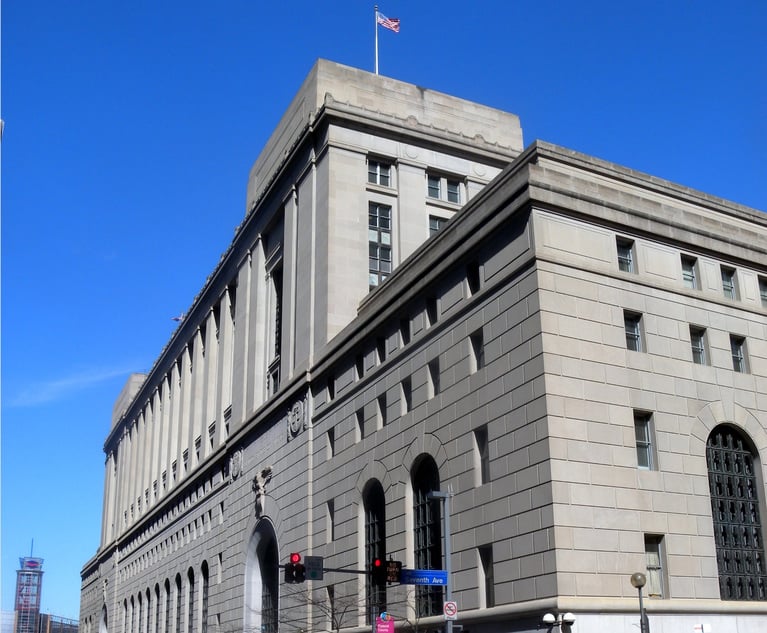
2nd Circuit Judge Sonia Sotomayor
image: Rick Kopstein/NYLJ
Is Judge Sonia Sotomayor a judicial activist? Just hours after Sotomayor's selection to fill the upcoming vacancy on the U.S. Supreme Court, special interest groups began the hunt for the dreaded activist in her, sifting decisions and speeches for evidence.
Soon she will answer her critics' drumbeat of accusations of judicial activism in her confirmation hearings -- a familiar drumbeat today wherever a judge or a nominee sits on the political spectrum.
Judicial activism means different things to scholars, politicians and special interest groups. But the term is often used in political rhetoric to identify decisions with which people disagree on ideological grounds and to pretend to criticize them in a neutral way, said Kermit Roosevelt of the University of Pennsylvania Law School and author of "The Myth of Judicial Activism: Making Sense of Supreme Court Decisions." "My preference would be for junking [the term]," he said.
But in a quest to give more meaning to the phrase, legal scholars and political scientists continue to seek the best measure of judicial activism. "There is no indisputable definition of judicial activism," said Frank Cross, who with Stefanie Lindquist, both of the University of Texas School of Law, authored the just-published "Measuring Judicial Activism." "But the way it's used in public to mean 'any decision I disagree with' is bogus."
THE ACTIVIST TEST
Although many have studied judicial activism, often focusing on the Supreme Court, Lindquist and Cross said no one has done it with the kind of detail that they have. Their approach is not through a single lens of, for example, overturning precedent, but through multiple lenses and across multiple cases.
They have conducted an empirical study of 22 justices on the Warren, Burger and Rehnquist courts, from the 1953 to the 2004 terms. They examined their voting in categories generally accepted by legal scholars and political scientists as associated with judicial activism: striking down federal, state and local laws; striking down executive branch actions; access to the courts, and overruling precedent.
"We scored activism on two different measures: how often the justice decided something activist, such as how often he or she struck down a law. We also measured the degree of ideological bias in doing so -- for example, how often did they strike a liberal state law in contrast to a conservative state law," Cross said.
After presenting the voting behavior of the justices in each of the categories assessed, the authors also produce a "final ranking" of activism, a single scale that ranks the justices from most to least activist, cumulating their scores in the different categories. The top five most activist justices were, from one to five: William Douglas, Hugo Black, Earl Warren, William Brennan and Thurgood Marshall -- liberal lions of the Warren Court. But coming in sixth behind Marshall was conservative Clarence Thomas.
The least activist justices were Felix Frankfurter, Warren Burger, Byron White and Harry Blackmun. The high court's most recent "swing" justices, Sandra Day O'Connor and Anthony Kennedy, ranked 14th and 11th, respectively. (Because they did not serve long enough to make their records broad enough for meaningful analysis, the authors did not include justices Harold Burton, Sherman Minton, Stanley Reed, Charles Evans Whittaker, Robert Jackson, Abe Fortas and Arthur Goldberg.)
"There are a couple of surprises," said Lindquist. "At the low end of our activism scale were justices not necessarily predictably there; for example, Warren Burger is relatively restraintist. On the activism end, there are justices who talk a lot about restraint but aren't restrained. One of those is Justice Thomas, and Scalia is not all that far behind. They are more activist than they probably like to admit."
[See Lindquist's evaluation of Sotomayor's published majority opinions since 2001, applying the political science tools and activism classifications used in "Measuring Judicial Activism."]
JUDGING SOTOMAYOR
And what about Sotomayor? The nominee has drawn fire from conservative groups, such as the Judicial Confirmation Network, and anti-abortion groups for her comments in 2005 that appellate courts make policy; her speech in 2001 about how her background as a Latina might affect her decision-making, and her participation in a per curiam opinion in the complex and controversial New Haven, Conn., firefighters' race discrimination challenge.
"To us, the most important factor in that 2001 discussion where she talks about race and gender was that it came from a judicial activist mindset," said Gary Marx, executive director of the Judicial Confirmation Network. "The judicial activist view is judge-centered. She will put factors outside the law as important contributing factors in decision-making. She isn't a servant of the law."
Another Sotomayor critic, M. Edward Whelan III, president of the Ethics and Public Policy Center and a former Scalia clerk, takes a narrower view of judicial activism than many of his conservative colleagues. "For constitutional cases, [judicial activism] necessarily has separation of powers resonance," he said. "It's best used to describe whether the judiciary intrudes on the realm of other branches. I try to emphasize it's only one category of error. Another category is judicial passivism, where courts don't enforce rights when they ought to."
Whelan, who is still "digesting" Sotomayor's opinions, added, "What I haven't seen by Judge Sotomayor is an embrace of determinate principles of constitutional interpretation. Without that, there are no bounds on the judicial role -- nothing to keep one from being a judicial activist."
Whelan said he is "very skeptical" of the field of political science and what can be shown by statistics on cases.
"That doesn't mean that I believe they can never shed insights," he added. A careful, qualitative review, he said, can be "more helpful" than some of the descriptive reviews of Sotomayor's work being offered by some Supreme Court practitioners and others.
Corey Yung of The John Marshall Law School in Chicago is engaged in an ongoing empirical study of judicial activism at the federal appellate court level. He is examining decisions from 2008 and has completed work on five U.S. circuit courts of appeals so far -- the 2nd, 3d, 4th, 7th and 8th. "All of the definitions of activism normally used come down to the judge believing his or her judgment is better than somebody else's judgment in the constitutional system," Yung said. Specifically for federal appellate courts then, one measure of activism is to examine when their judges reverse district court decisions, he said.
If an appellate judge, in cases calling for deferential review, reverses district courts at a higher rate than in cases in which nondeferential review is the standard, that judge is activist, according to Yung's measure.
Based on preliminary data, Yung said, Sotomayor is "in the mainstream, clearly, and less activist than the average judge -- more deferential to district courts than the average judge among the five circuits I've looked at." And, he added, she is less activist relative to her 2d Circuit peers. The average judge's score in his data now is 10.40. Sotomayor scores an 11.71. The lower the score, the more activist the judge, Yung said.
And how does she rank in criminal cases? Yung reports that the average judge's rank is 22.65; Sotomayor's rank is slightly more activist: 19.05.
Lindquist and Cross also have begun analyzing Sotomayor's opinions. "They don't look activist," said Cross, but he cautioned that there is difficulty extrapolating from what a judge has done on the circuit court to what that judge will do on the Supreme Court. "Public discussion of judicial activism is shallow and maybe it always will be," said Cross. "But the goal is to change the academics' view in the short term, and maybe that will seep down into the public in the long term."
Visit 'The Choice' for The National Law Journal's ongoing coverage of the confirmation process of Sonia Sotomayor as U.S. Supreme Court Justice.


Reader Comments