Incisive Media's Law.com
  • Law.com Network
  • Legal Web
Register for Law.com Newswire
Newsletters
RSS

Law.com Home > N.Y. Appeals Court Backs Judicial Pay Raise

Font Size: increase font decrease font

N.Y. Appeals Court Backs Judicial Pay Raise

With Albany unwilling to give raises during recession, question may be headed for showdown at state's high court

Noeleen G. Walder

New York Law Journal

June 03, 2009

  • deliciousdel.icio.us
  • digg Digg
  • redditReddit
  • facebookFacebook
  • googleGoogle Bookmarks
  • newsvineNewsvine
  • linkedinLinkedIn
  • mixxMixx
  • stumbleuponStumbleupon
  • Print
  • Share
  • Email
  • Reprints & Permissions
  • Post a Comment

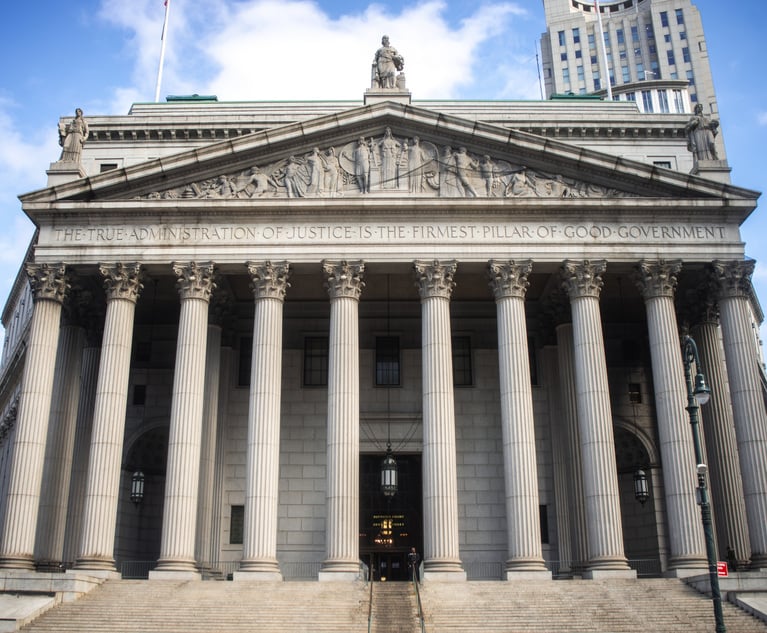
The New York Legislature's decade-long failure to give the state's 1,300 judges a raise violated the separation of powers doctrine by subordinating the judges to the "whims and caprices" of politicians who continually linked their pay to unrelated issues, a Manhattan-based appeals court ruled unanimously Tuesday.

The Appellate Division, 1st Department, gave the Legislature 90 days to adjust judicial compensation to reflect an approximately 30 percent increase in the cost of living since 1998, when the last judicial raise was enacted.

However, the ruling probably will not be the last word on the pay issue. The Appellate Division, 3rd Department, already had dismissed a similar lawsuit last year.

With Albany officials unwilling to grant raises in the midst of a recession, the question apparently is headed for a final showdown at the Court of Appeals.

The 1st Department faulted lawmakers for making a judicial salary increase "contingent on its own success in achieving a legislative pay increase."

"Linkage, as employed in these circumstances, manifested an abandonment of any pretense to an objective consideration of judicial compensation unimpeded by extraneous political considerations," Justice Peter Tom wrote for the panel in Larabee v. Governor, 4761-4761A. "These acts and their ramifications necessarily undermine the carefully constructed architecture of New York government."

The panel observed that the Legislature, by subordinating the judiciary to its own priorities, had brought the courts "closer to the world of politics than is tolerable for the disinterested functioning of a court system."

The court concluded, "The basic tenet of the separation of powers doctrine, to promote and maintain the independence and stability of each branch of government, has been violated."

The suit against the state, the governor and legislative leaders was brought by four judges: Manhattan Family Court Judge Susan Larabee, Cattaraugus County Family Court Judge Michael Nenno, Manhattan Civil Court Judge Geoffrey Wright and Manhattan Criminal Court Judge Patricia Nunez.

The panel's decision affirms a ruling by Manhattan Supreme Court Justice Edward Lehner holding that the linkage of judicial raises to other issues is unconstitutional. Lehner's order was stayed in August 2008 pending Tuesday's decision.

The four Larabee plaintiffs also claimed their $136,700 annual salary has been unconstitutionally diminished in light of inflation in violation of the compensation clause of the state constitution. Like Lehner, the 1st Department rejected that claim.

The 1st Department panel also affirmed Lehner's decision dismissing the action against the governor, saying he was not responsible for inaction on the pay hikes.

Larabee is one of three suits brought over the issue of judicial pay raises.

DIFFERING RESULTS

The 3rd Department last year dismissed Maron v. Silver, 58 A.D. 3d 102, holding that the judge plaintiffs in that action had "failed to allege a discriminatory attack on the judicial branch that has impaired the Judiciary's independence and ability to function."

A third suit, Kaye v. Silver, 400763/08, filed by former Chief Judge Judith S. Kaye, argued that the pay of Supreme Court justices, now $136,700, should be on par with the $169,300 earned annually by federal district court judges. That case is pending before Lehner; he told the parties in a conference call last week to expect a decision soon.

The 1st Department drew a contrast between its ruling and that of the upstate appellate court in Maron, which found no actual harm from the lack of a raise.

Justice Tom wrote that evidence of "a present impairment of the judicial system" is not a prerequisite to the viability of a separation of powers claim.

Rather, the panel concluded that "the threat to judicial independence arises not only from specific instances of legislative or executive overreaching, but, also when political jousting erodes the institutional barricades which protect the judicial bench."

The panel argued that the whole pay issue was critical to the future of the judiciary.

The "sheer complexity of much of New York's litigation, and its often crushing caseloads, require a fully operational, efficient and well-informed third branch of government, capable of managing its own affairs and presided over by well-qualified jurists trained to dispense justice efficiently and fairly," Tom wrote.

While judicial salaries have lost between one-quarter and one-third of their value since 1998, he noted that compensation for "New York legal professionals rose dramatically, with the anomalous result that salaries of young, newly minted lawyers often exceed those of the experienced jurists before whom they appear."

There has been wide support in New York's legal community for judicial raises, but the idea always has been stalled by political infighting. Former Chief Judge Kaye proposed the creation of a commission to decide judges' compensation. That suggestion made "sound sense," the panel said.

In addition to Justice Tom, the appeals panel in Larabee included Presiding Justice Luis A. Gonzalez and Justices Eugene Nardelli, Karla Moskowitz and Dianne T. Renwick. Arguments were heard on Nov. 18.

Thomas Bezanson of Cohen & Gresser, along with George Bundy Smith and J. Carson Pulley of Chadbourne & Parke, represented the Larabee plaintiffs.

"Today the state can celebrate the vindication of the separation of powers and judicial independence under the state constitution. It's a great day for state, constitution, judiciary and the people it serves," Bezanson said in an interview.

Richard H. Dolan, David J. Katz and Erik S. Groothuis of Schlam Stone & Dolan represented the state and Gov. David A. Paterson.

Dolan said Tuesday's ruling had created a "sharp conflict" with the 3rd Department's holding in Maron. However, he said that ultimately the governor and legislative leaders would have to decide whether to appeal Larabee to the Court of Appeals.

This year's state budget includes a "dry appropriation" of $48 million for a salary increase, but no authorization. Paterson said earlier this year that he supports a raise but given the grim economy, the state is in no position to raise anyone's pay.

"We are pleased that the claims against the governor were dismissed and we do not intend to appeal that aspect of the ruling," Marissa Shorenstein, a spokeswoman for Paterson, said in a statement. "However, the claims against the state, which is also a defendant, have not been dismissed and we will carefully analyze the decision to determine whether the state will appeal."

A spokesman for Assembly Speaker Sheldon Silver, D-Manhattan, said, "We are reviewing the decision."

The attorney general's office, which represented the state Senate and Assembly, and Senate Majority Leader Malcolm Smith, D-Queens, did not return calls for comment.

A spokesman for the court system said it would be inappropriate to comment on the ruling.

Bernard W. Nussbaum of Wachtell, Lipton, Rosen & Katz, who represented the chief judge in Kaye v. Silver, filed an amicus brief in Larabee.

In an e-mail, Nussbaum wrote, "We hope the governor and the Legislature will do their duty and, within the next 90 days, adjust judicial compensation to reflect the increase in the cost of living since 1998. If not, we expect to be in the Court of Appeals by the end of this year."

Attorney Steven Cohn of Carle Place, who is representing the Maron plaintiffs, said that if the Larabee ruling is appealed to the Court of Appeals, he is sure the court will consolidate that case with Maron.

But Cohn said he hoped Tuesday's ruling would convince the Legislature to accommodate the judges with a pay raise.

"Budget issues aside, I think even the Legislature is realistic enough to know it's time," Cohn said. "This may be the catalyst that enables it to get done."

Stroock & Stroock & Lavan filed an amicus brief for the Association of Justices of the Supreme Court of the State of New York, the Supreme Court Justices Association of the City of New York Inc., and the New York State Association of City Court Judges.

Attorneys from Sullivan & Cromwell filed an amicus brief for the New York County Lawyers' Association.


Subscribe to New York Law Journal

  • Print
  • Share
  • Email
  • Reprints & Permissions
  • Post a Comment

Advertisement

Top Stories From Law.com

Legal Technology

  • Public Performance in the Digital Age

Corporate Counsel

  • United Technologies Takes a Stand, Puts Billable Hour 'on Life Support'

Small Firm Business

  • Holiday Parties: Keeping Expenses Low and Deductibility High

Advertisement

lawjobs.com

TOP JOBS

MORE JOBS >>

POST A JOB >>

Advertisement

About ALM  |  About Law.com  |  Customer Support  |  Reprints  |  Privacy Policy  |  Terms & Conditions
Close [ X ]