An antitrust action will proceed against Chinese companies that claim they were compelled by their government to fix the price of vitamin C in violation of U.S. law.
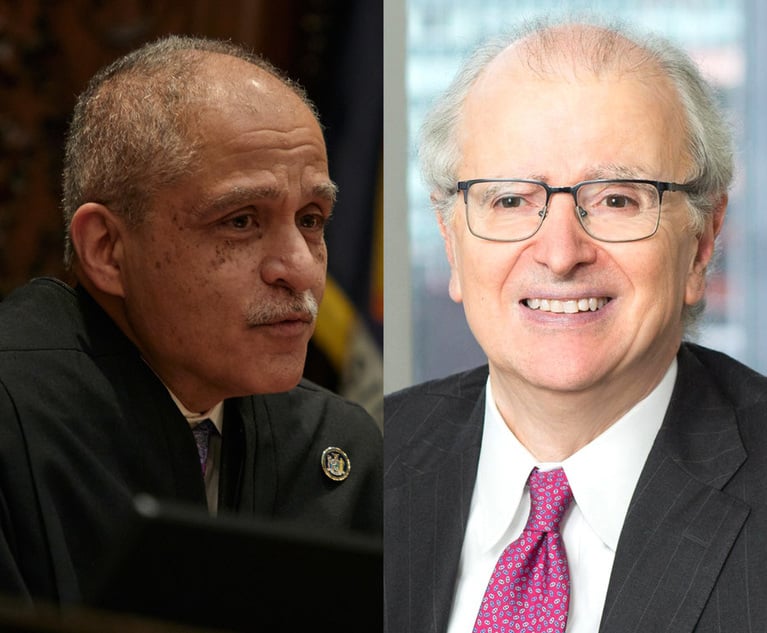
Eastern District of New York Judge David Trager held in In Re Vitamin C Antitrust Litigation, 06-mdl-1738, that the record was too "ambiguous" to foreclose further inquiry into the voluntariness of the business decisions by four major manufacturers, who together control more than two-thirds of the market.
"[I]t is not clear ... whether defendants were performing a government function, whether they were acting as private citizens pursuant to governmental directives or whether they were acting as unrestrained private citizens," Judge Trager said.
In rejecting a motion to dismiss, the judge rebuffed an amicus brief submitted by the Chinese Ministry of Commerce. He noted that the Chinese government had never come before a U.S. court to present its views, a fact that "alone demonstrates the importance" of the case to them.
Plaintiffs allege that the Chinese companies Hebei Welcome, Jiangsu Jiangshan, Northeast Pharmaceutical Group (NEPG) and Weisheng Pharmaceutical Co. acted to raise prices and limit the supply of vitamin C in violation of the federal Sherman and Clayton acts.
According to the decision, beginning in December 2001, the companies met with the Association of Importers and Exporters of Medicines and Health Products of China and formed a cartel to control prices. At that point, they controlled 60 percent of the market.
They claim the formation of the alleged cartel led to an increase in the price of vitamin C in the United States to $7 per kilogram between December 2001 and December 2002 from $2.50 per kilogram.
As the demand and price fluctuated (reaching a high of $15 per kilogram in April 2003 during the height of the SARS outbreak), defendants allegedly participated in various schemes that kept prices artificially high while the Chinese manufacturers enjoyed significantly lower costs of production. By 2006, their share of the market had reached 68 percent.
American manufacturers, including the Ranis Co. and Animal Science Research Inc., sued their Chinese competitors in Massachusetts, California and New York courts. The cases were consolidated and assigned to Judge Trager.
The defendants filed a motion to dismiss. They did not deny the allegations for purposes of the motion, but invoked the "acts of state," "foreign sovereign compulsion" and "international comity" doctrines.
The judge observed that all of these doctrines were premised on the act of a foreign government, in this case China.
The act of state doctrine holds that a foreign government may not be questioned by another nation's courts for actions within its own borders.
The judge said the compulsion doctrine "recognizes that a defendant trying to do business under conflicting legal regimes may be caught between the proverbial rock and a hard place where compliance with one country's laws results in violation of another's."
Finally, comity is the recognition that one nation allows within its territory to the laws of another nation.
Here, however, the judge said there was not enough evidence to determine that any of these doctrines applied to the defendant's price fixing action, despite the arguments of the Chinese government.
The Ministry of Commerce in its brief identified the "trade association" that allegedly facilitated the cartel as the Chamber of Commerce of Medicines and Health Products Importers & Exporters.
The brief argued that such chambers, in contrast to their voluntary nongovernmental U.S. cousins, "have played a central role in China's shift from a command economy to a market economy."
Although the ministry noted it did not decide specific prices, the defendants and the ministry insisted the companies could not have exported vitamin C without conforming to the agreed-upon price.
Judge Trager said the Chinese position was owed deference but was not conclusive. Further, he said it was contradicted by other documents in the case, which suggested a "complex interplay" between the defendants and the Chamber that made it difficult to determine the degree of defendants' independence in setting prices.
The judge pointed out the existence of government compulsion in setting vitamin C prices had been "hotly contested" by the parties. And he noted that the Ministry of Commerce "has been forthright in its admission that Chinese law is not as transparent as that of the United States or other constitutional or parliamentary governments."
William A. Isaacson of Boies, Schiller & Flexner, who represented Ranis and Animal Science, said the case is particularly interesting because it constitutes a passing-of-the-baton of sorts for vitamin antitrust cases.
In the late 1990s and early 2000s, vitamin price-fixing cases were brought against European manufacturers, leading to multi-billion dollar settlements with the U.S. government, European Commission and other entities, including businesses and retailers.
"And now Chinese manufacturers have taken over the cartel for vitamin C. It was fascinating that this was starting up again," Isaacson said.
Stephen V. Bomse, Richard S. Goldstein and August T. Horvath of Heller Ehrman (following Heller's recent dissolution, Horvath is now with Kelley Drye & Warren, while Goldstein and Bomse moved to Orrick, Herrington & Sutcliffe) represented Jiangsu Jiangshan.
Charles H. Critchlow of Baker & McKenzie represented Hebei Welcome Co.
Daniel S. Mason of Zelle Hofmann Voelbel Mason & Gette represented China Pharmaceutical Group and Weisheng. Mason declined to comment.
Kenneth A. Lapatine represented NEPG.
Joel M. Mitnick of Sidley Austin represented the Chinese Ministry of Commerce. He also declined to comment.