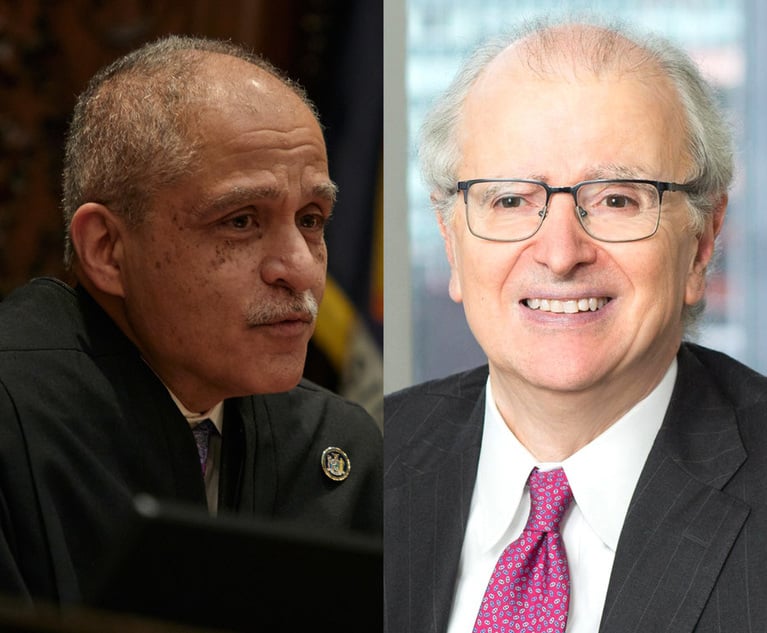
Professor Kyron Huigens, Benjamin N. Cardozo School of Law
Courtesy of Benjamin N. Cardozo School of Law
Barack Obama's opponents have called his supporters "a cult of personality." In less contentious terms, journalists have begun to wonder whether Democrats really have much of an idea who their presumptive nominee is and what he stands for. Anyone who claims to know the full truth about even the public man, what he really thinks, and how he thinks, is probably deluded. The Obama supporter who adds that, "Of course I understand him. He's like me," must be the most deluded of all.
I have to confess that I think I know Obama's mind. He's like me -- a legal scholar.
Obama is a graduate of one of the best law schools in the country and has taught on a part-time basis at one of the others. Every law school produces at least one scholarly journal, usually its flagship journal, that is edited by students. Obama was the president of the Harvard Law Review, a political office of sorts that, nevertheless, gave him an opportunity to work with accomplished, often brilliant, scholars.
Obama's legal education, his law review work and his teaching have produced a presidential candidate whose positions on major issues have been described as nuanced, compromised, centrist or insincere. They might be all or some of these things, but many of them are also legally sophisticated. This matters to anyone who wants to truly understand Obama's thinking. Legal analysis cannot be adequately portrayed in political terms, and to push Obama's beliefs back and forth along the conventional left-right spectrum badly misrepresents them.
Consider his reactions to one of the Supreme Court's major rulings in the term just completed: the Court's holding that child rapists may not be executed. Obama's position has been described as a move from the left to the center of the political spectrum, or to the right of liberal opinion. From a legal point of view, however, Obama's position is unremarkable. Given this, it is likely that his reaction to the decision does not reflect a shift in his beliefs at all.
The law of capital punishment under the Eighth Amendment presents the Court with two options in dealing with the death penalty. It can ban the penalty for certain offenses or offenders, or it can regulate death sentencing. A state's rules for such sentencing, as a constitutional matter, have to require at least one aggravating factor before a death sentence can be imposed, and must permit consideration of every conceivable mitigating factor. A third approach, outright abolition, has never commanded more than a small minority of votes on the Court. (The belief that the Court banned and then reinstated capital punishment in the early 1970s is incorrect.)
To a legal scholar, a ban for a particular offense can seem too much a matter of one-size-fits-all -- and regulated death sentencing ensures, if not an error-free process, at least an unusually careful and deliberate one. The Court's most recent opinion took the first approach to cases of child rape. Obama said that he would have taken the second route. The advantage of this, as he explained, is that it allows capital punishment to be imposed, or not, on the merits of each individual case. Reasonable minds can differ in choosing between these two options, and which option a candidate chooses says a great deal about him. But what it does not show is whether the candidate has changed his position on the issue or where his position is on a left-right political spectrum.
A legal scholar might be opposed to abolishing the death penalty even in part -- a conservative-sounding position -- and yet base this on a liberal penchant for arriving at a nuanced decision after hearing from and accommodating all sides. A legal scholar might favor abolition -- a liberal position -- and also think that the Court is the wrong body to declare abolition, or that its current approach to the Eighth Amendment improperly authorizes the justices to make an independent judgment on "the evolving standards of decency" -- the sum and substance of the conservative case against judicial activism.
These particular choices would put Obama right where we find him -- on the opposite side from the Court on the question of banning the death penalty for child rapists. Not only are these choices impossible to fix on the left-right spectrum, they also are the kind of fundamental choices about the rule and role of law that legal scholars tend to make and then stick with until an especially strong argument persuades them otherwise.
It is speculation to say that this is Obama's position. He has not articulated it this way. But the anti-intellectualism of his opponents -- people who think George W. Bush's C-average is a good thing -- makes it politically dangerous to explain complex issues in complex ways. And the conventions of political reporting in this country -- which emphasize the horse race instead of the substance of campaigns -- make it almost impossible to get this level of detail across to the public. All we have to go on is a consistent pattern of positions that sophisticated legal arguments make sense of.
It might be unsurprising that Obama's reactions to Supreme Court cases can be described in legal instead of political terms -- though this has not stopped journalists from describing them in political instead of legal terms -- but the same pattern appears in his Senate vote last week in favor of a compromise bill on warrantless wiretapping. The bill is reviled on the left because it expands the government's power to conduct electronic surveillance. This is consistently described on the blogs as a degradation of the Fourth Amendment.
Obama has not characterized it this way and, given his vote, does not appear to view it this way. There is a good reason for this. The bill does not violate the Fourth Amendment. Since at least the 1980s the requirement of a warrant has been the exception, not the rule, in search and seizure cases. A warrant is required only in criminal cases, broadly speaking, and not always even there.
Non-criminal searches of the kind conducted under the Foreign Intelligence Surveillance Act are known as "special needs" searches, and the Fourth Amendment requires only that these be reasonable. FISA itself uses the term "probable cause" in an entirely different, and less stringent, sense than that used in criminal cases. Whatever its faults, the FISA compromise probably meets the minimal demands that the Fourth Amendment places on it. If Obama's take on the situation is less dire than that of his supporters on the left, it is not necessarily because he has moved to the right.
None of this really justifies my sense that I know Obama's mind. But beyond these issues and the way he handles them, I sense a certain temperament and a style of thinking that sounds and feels very familiar. I would be surprised if many of my colleagues in legal academia did not sense it too. Whether this counts as a reason to vote for Obama is, of course, another question.
Kyron Huigens is a professor of law at the Benjamin N. Cardozo School of Law, Yeshiva University. He specializes in criminal law and procedure, and the death penalty.