Law.com
  • News
    • Newswire
    • Supreme Court
    • International
    • Legal Blog Watch
    • The Hot Seat
    • Video
  • Publications
    • The American Lawyer
    • Corporate Counsel
    • Law Technology News
    • The National Law Journal
    • New York Law Journal
    • New Jersey Law Journal
    • Connecticut Law Tribune
    • The Legal Intelligencer (PA)
    • Daily Business Review (FL)
    • Delaware Law Weekly
    • Daily Report (GA)
    • The Recorder (CA)
    • Texas Lawyer
    • Publication E-Alerts
    • More Publication Sites
  • Legal Research & Directories
    • Books Online
    • Smart Litigator
    • ALM Experts
    • Verdict Search
    • Court Reporters
    • Legal Dictionary
    • LegalTech® Directory
    • Newsletters
    • More Directories
  • Surveys, Lists & Rankings
    • Amlaw 100
    • NLJ 250
    • Global 100
    • The A-List
    • ALM Legal Intelligence
    • Surveys
    • More Lists & Rankings
  • Special Reports
  • lawjobs.com
  • LawCatalog Store
  • CLE & Events
    • CLE Center
    • ALM Events
    • LegalTech
    • Virtual LegalTech
    • Insight Legal Events
    • Webinars
Home
 
Article
Twitter LinkedIn RSS
Sign Up for Newsletters

Law.com Home > Supreme Court Strikes Down D.C. Gun Ban

Font Size: increase font decrease font

Supreme Court Strikes Down D.C. Gun Ban

By Tony Mauro All Articles 

Legal Times

June 27, 2008

  •    
  •    
  •    
  •      
 
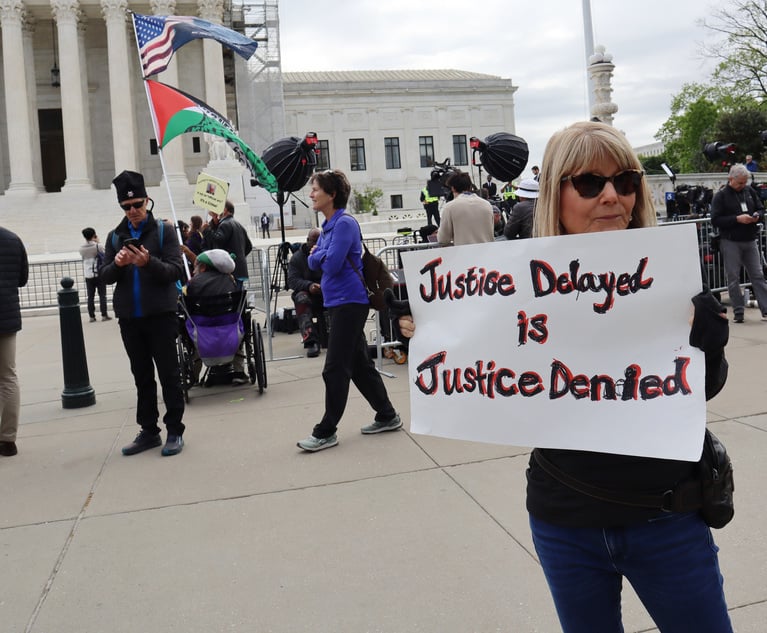
Protestors stand outside the Supreme Court following the decision to strike down D.C.?s handgun ban.

Protestors stand outside the Supreme Court following the decision to strike down D.C.?s handgun ban.
Credit: Diego M. Radzinschi/Legal Times

Related Items

  • Supreme Court Hears Arguments in D.C. Gun Ban Case
  • D.C. Gun Case Aimed at High Court

In a historic 5-4 decision Thursday, the Supreme Court declared for the first time that the Second Amendment protects an individual right -- not a collective or militia right -- to keep and bear firearms for self-defense.

The ruling ended the Court's nearly 70-year aversion to considering the meaning of the Second Amendment's oddly constructed language: "A well regulated Militia, being necessary to the security of a free State, the right of the people to keep and bear arms, shall not be infringed."

The immediate result of the ruling in District of Columbia v. Heller was to strike down the District's tough 32-year-old ban on handguns and its trigger-lock requirement on other firearms, which the city had said were essential to contain violence in the nation's capital.

The original plaintiff, D.C. resident Dick Heller, said immediately after the decision was handed down that he would seek a handgun permit soon, but it may be weeks or months before the D.C. bureaucracy, unaccustomed to handling gun permits, is ready to act. Mayor Adrian Fenty expressed disappointment at a press conference, adding, "More handguns will lead to more handgun violence."

"This is a great moment in American history," Wayne LaPierre, vice president of the National Rifle Association, said in a statement. The NRA did not initiate the D.C. challenge but eventually embraced it. But Chicago Mayor Richard Daley, whose city has a handgun law similar to D.C.'s, said the decision could bring a "return to the days of the Wild West," according to news reports.

The high court ruling was the last opinion issued by the justices before adjourning for the summer, striking a discordant note at the end of an otherwise fairly harmonious term. The Court issued far fewer 5-4 decisions this term than it had handed down the previous term.

In the gun case, Justice Antonin Scalia led the majority in analyzing the words of the Second Amendment and the views of its framers and concluding that "they guarantee the individual right to possess and carry weapons in case of confrontation."

But the landmark ruling, which placed bitter divisions on the Court on full display, is likely to mark the beginning, not the end, of litigation over Second Amendment rights as gun owners and local governments test the contours of the right enunciated by the Court.

Scalia wrote that the right he was announcing, as with other constitutional rights, "is not unlimited." The ruling should not "cast doubt," he added, on restrictions such as barring possession of firearms by felons or the mentally ill or forbidding carrying arms near schools or in government buildings. He also indicated that the use of certain types of weapons could be restricted without running afoul of the Second Amendment.

But the majority did not define a standard of review for judging which restrictions are or are not constitutional, and it did not specifically rule that the Second Amendment applies to the states -- a step that the Court has taken in the past to ensure that other parts of the Bill of Rights limit state as well as federal restrictions on individuals.

Both omissions from the ruling virtually guarantee a wave, if not a generation, of legal battles. Scalia suggested as much in his 64-page opinion when he wrote, almost defensively, "Since this case represents this court's first in-depth examination of the Second Amendment, one should not expect it to clarify the entire field."

In dissent, Justice John Paul Stevens also said the majority's bottom line "does not tell us anything about the scope of that right."

Stevens clashed with Scalia over the meaning of United States v. Miller, the 1939 decision that briefly discussed the Second Amendment. To Stevens, that decision defined the Second Amendment as pertaining to militia gun use. But it meant the opposite to Scalia, who was joined by Chief Justice John Roberts Jr. and Justices Anthony Kennedy, Clarence Thomas and Samuel Alito Jr.

Stevens' unusually pointed dissent accused the majority of injecting the Court into what are essentially political debates over gun control. The decision, he wrote, "will surely give rise to a far more active judicial role in making vitally important national policy decisions than was envisioned at any time in the 18th, 19th, or 20th centuries."

By contrast Scalia insisted that he was acting with judicial modesty.

"Undoubtedly some think that the Second Amendment is outmoded in a society where our standing army is the pride of our Nation, where well-trained police forces provide personal security, and where gun violence is a serious problem," Scalia wrote. "That is perhaps debatable, but what is not debatable is that it is not the role of this Court to pronounce the Second Amendment extinct."

Justice Stephen Breyer also penned a dissent, arguing that even if the Second Amendment articulates an individual right, the D.C. gun ban is reasonable and constitutional. As a response to high levels of urban violence, Breyer said, the handgun ban is "a permissible legislative response to a serious, indeed life-threatening, problem."

Justices David Souter and Ruth Bader Ginsburg joined both dissents but did not write separately.

The ruling represented a victory for Scalia not only in its result but also in the methodology justices used in their opinions, said Northwestern University School of Law professor John McGinnis. "All justices adopted an originalist approach, suggesting that originalism commands consensus support, at least when the issue is whether a right that is in the constitution can be restricted." Cato Institute scholar Robert Levy, who was the financial backer of the challenge to the D.C. gun law, said Thursday the Court had finally rediscovered the Second Amendment. "Because of Thursday's decision, the prospects for reviving the original meaning of the Second Amendment are now substantially brighter."

The NRA's LaPierre said, "I consider this the opening salvo in a step-by-step process of providing relief for law-abiding Americans everywhere that have been deprived of this freedom."

Gun control supporters, while disappointed with the ruling, said it could have been worse.

"Our fight to enact sensible gun laws will be undiminished," said Paul Helmke, president of the Brady Campaign to Prevent Gun Violence in a statement. "While we disagree with the Supreme Court's ruling, which strips the citizens of the District of Columbia of a law they strongly support, the decision clearly suggests that other gun laws are entirely consistent with the Constitution."


Subscribe to Legal Times

Find similar content

Companies, agencies mentioned

    
  • Brady Campaign
  • Northwestern University School
  • National Rifle Association
  • Cato Institute
  • Supreme Court

Most viewed stories

    
  1. Court Officials Seek to Reform Process of Naming Acting Justices
    •      
  2. The 2013 Am Law 100
    •      
  3. Prolific ADA Plaintiff Faces Nemesis in Harassment Suit
    •      
  4. Lawyers Sanctioned Over Porn Lawsuits File Appeal
    •      
  5. Law for Laymen
    •      
lawjobs.com

TOP JOBS

MORE JOBS

POST A JOB

From the Law.com Network

Hiring Interns? Be Sure to Do It Right

ACC Weighs in on Arizona's In-House Pro Bono Rules

Ex-Dewey Partners Face New Foe in Firm's Bankruptcy

S&C Adds Linklaters Restructuring Partner in London
  •      
    • Subscription Required

Contrite Companies Can Win Forgiveness in Bribery Cases
  •      
    • Subscription Required

Plaintiffs Want to See Toyota's 'Crown Jewels'
  •      
    • Subscription Required

Enron Sandbox Stirs Up Private Data, Again

LegalTech West Coast Wraps Up With Ethics, VC News

In Tricky Prosecutions, Judges Play Peacemakers

Ropers Majeski Tries to Re-Invent Itself
  •      
    • Subscription Required

Fla. Attorneys Lead Force-Placed Insurance Fight

Lawsuit Names Missing Fla. Attorney for Alleged Fraud
  •      
    • Subscription Required

Summer Programs Still in a Drought

Lawyer Not Covered for Alleged Malpractice at Prior Firm
  •      
    • Subscription Required

The Affordable State-Specific Practice Solution
Available in NY, NJ, PA and CT editions - research, draft and prepare even the most complex cases with ease.

Firm Takes Another Hit in Bid for 'Unconscionable' Fees

New York's Martin Act Faces Test in Challenge to 2005 Case

Castille Testifies in Favor of 'Civil Gideon' Funding

Workers' Comp Judges Can't Fight Rescinded Raise
  •      
    • Subscription Required

Law Schools Are Looking Beyond LSATs, Says Mich. Dean

Is Freezing Your Eggs the Solution?

Advising Clients on Weather and the Workplace
  •      
    • Subscription Required

Texas Sues BP, Others Over Deepwater Oil Spill Disaster
  •      
    • Subscription Required

'Follow That Escapee!'

Judge Who Tossed Defense Counsel Accused of 'Partiality'
  •      
    • Subscription Required

Corporate Bribery Case Part Of National Trend
  •      
    • Subscription Required

Court Continues To Grant Lawyers Fraud Immunity
  •      
    • Subscription Required

  • About |
  • ALM Properties |
  • ALM Reprints |
  • Customer Support |
  • Privacy Policy |
  • Terms & Conditions |
  • ALM User License Agreement
ALM Media