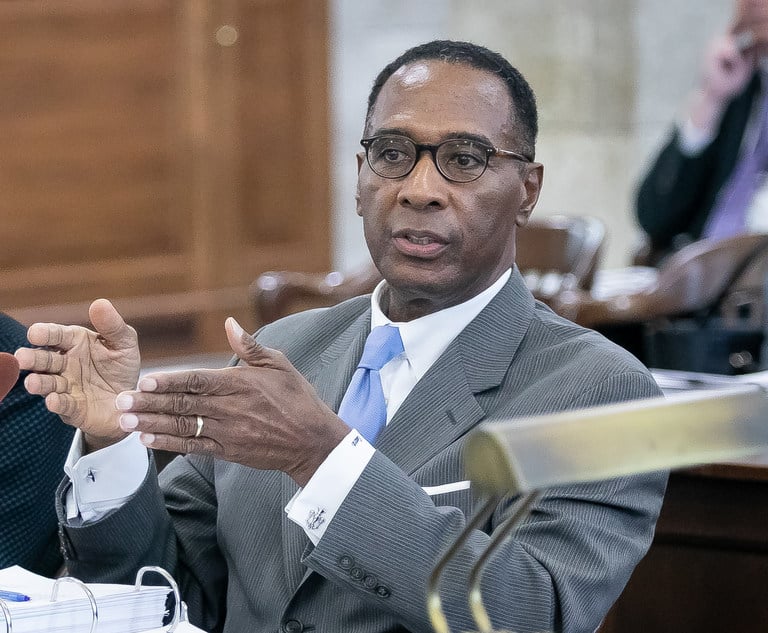
William "Jim" Haynes II
When a company recruits a prominent government official, it's usually eager to put the word out immediately. But Chevron Corp. took more than a month to publicly confirm that it had hired William "Jim" Haynes II, the controversial former general counsel of the Pentagon. Chevron officials say that they didn't make a big deal of Haynes' hiring because they didn't think it was newsworthy.
Haynes, however, is very much a man in the news. In addition to having run one of the biggest law departments in the federal government, Haynes has drawn fire for his role in developing the Bush administration's detainee interrogation policies. Democratic senators maintained that Haynes had approved interrogation procedures that amounted to torture and were able to kill his nomination to a federal judgeship.
The U.S. Department of Defense announced Haynes' resignation as general counsel Feb. 25. Two days later Chevron general counsel Charles James sent a memo to the company's management committee stating that Haynes would be coming aboard as chief corporate counsel. Haynes, who will report to James, will manage the 45-attorney legal department.
Chevron spokesman Kent Robertson says that the company did not make an external announcement about Haynes' hiring. "I don't think we thought it was newsworthy," Robertson says. Word of Haynes' employment by Chevron began appearing in blogs last week, and was reported on Newsweek's Web site April 5.
The San Ramon, Calif.-based oil giant got the news out much more quickly when it hired James as general counsel in 2002. James was then an assistant attorney general in charge of the antitrust division at the U.S. Department of Justice. Chevron announced James' hiring in a press release issued on the same day that Justice announced his departure from the department.
James and Haynes bonded during their overlapping tenure in the Bush administration. "I've known Jim since we both served in the administration and have always respected his world-class legal talent," James said in a statement for this article. "I expect that Chevron will benefit from his legal skills, professional maturity and judgment."
Haynes is scheduled to start his new post in early May. He is currently traveling on family business and unavailable for comment, according to Robertson.
Throughout his career, Haynes has alternated between the public and private sector. From 1990 to 1993 he served as general counsel of the U.S. Army. He then became a partner at Jenner & Block, and later he became an associate GC at General Dynamics Corp.
Haynes returned to the Pentagon in 2001 when he became the Defense Department's general counsel. As the Pentagon's top civilian lawyer, he oversaw more than 10,000 military and civilian attorneys. In the press release announcing his resignation, Secretary of Defense Robert Gates noted that Haynes had served as the Pentagon's GC "longer than anyone in history."
While everyone at the Defense Department has had a full plate in recent years, Haynes has been particularly scrutinized for his involvement with the interrogation policies for detainees held at Guantanamo Bay and in Iraq and Afghanistan. His critics have charged that Haynes ignored the objections of Pentagon lawyers who thought that the interrogation guidelines went too far [see "Under Interrogation," Corporate Counsel, September 2006].Testifying before the Senate Judiciary Committee in 2006, Haynes said that government officials had been forced to make "difficult decisions" after 9/11, but that "even terrorists must be treated humanely."
Chevron spokesman Robertson says that while the company is "aware that there are peripheral issues surrounding Jim, they have not been a focus for us."
Perhaps not. But still, corporate PR expert Gene Grabowsky says that controversy can affect how a company handles the hiring of a top government official. "Normally, of course, you'd publicize it very broadly, because it would be a feather in your cap," says Grabowsky, senior vice president and head of the crisis practice at Levick Strategic Communications, a Washington, D.C.-based PR firm.
However, Grabowsky adds that "there are times when you might not" make such a big deal, especially when the new employee has been the subject of unfavorable coverage. Grabowsky cites the example of Michael Deaver, a former deputy chief of staff under President Reagan.
Shortly after Deaver left the White House in 1985, he was accused of influence peddling and later convicted of perjury. Grabowsky says that when Deaver joined Edelman, the international public relations firm, in 1992, "They did not announce it immediately. Instead, they let the news trickle out gradually." The strategy, which Grabowsky says other companies have used, was to "let the new person build some success in their position first."