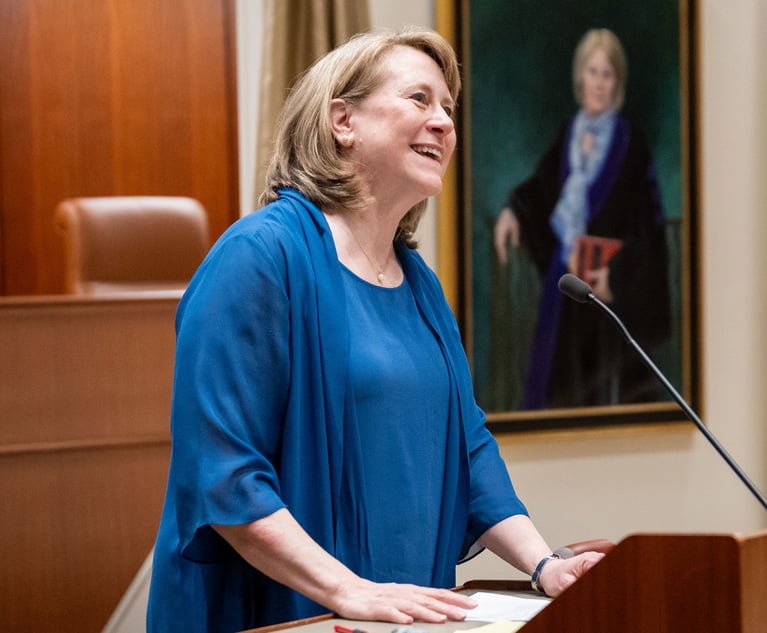
Boies, Schiller & Flexner partner Stephen Zack is to begin his one-year stint as the American Bar Association's new president today. Zack, who was born in Cuba, will be the first Hispanic-American to lead the ABA. Among the highlights of his 35-plus years practicing law: working on behalf of former vice president Al Gore during the landmark Bush v. Gore case. Zack -- who plans to develop a program for lawyers to teach civics classes to high school students -- spoke with The Am Law Daily about some of his other priorities as he assumes his position, including access to legal services, diversity in the legal profession, and the struggle to prepare an adequate legal framework for addressing the fallout from natural or man-made disasters.
How has the current fiscal crisis affected court funding and access, and what will the ABA do on this front?
I think that's the most important question you could ask me, and that is why we're forming a task force on preservation of the justice system. A lot of people see how this economic crisis may affect them in their personal lives, which is very significant, but until now I don't think there has been a global understanding of how disastrous it's been to our court system.
How disastrous has it been?
Eight states have resorted to closing courts on certain days every month. Nineteen states have instituted furloughs. In Vermont, for example, one day per month they not only close the courts, but of course they don't pay for that one day. ... The National Center of State Courts says that there's a hiring freeze in 26 states, and there have been layoffs in 11 states. Where I think we kind of have missed the boat in our previous messages is that the public's heard a lot about judicial salaries, and there's no question that judicial salaries are in need of help, but that's really not the focus of this discussion, because we're talking about public defenders, prosecutors, state attorneys, the entire justice system is at stake here. It's a very, very serious situation that we are going to put a spotlight on.
Does that include the call by the ABA for a new, independent court for immigration cases?
Yes. That's part of our recent report ["Reforming the Immigration System"] that was the result of 15,000 pro bono hours. While people are rightfully concerned about immigration, and concerned that there is no solution, this is the beginning of a solution. (Download the report [pdf])
You're the first Hispanic president in the ABA's history. What does that mean to you and to the institution, and what sort of legal barriers remain in the U.S. for Hispanics?
One of the four mission statements of the ABA is to increase diversity in our country, and in our profession. Hispanics today are the largest single minority and the fastest-growing minority. The census says that by the year 2050, one out of every three Americans will have some kind of Hispanic background.
We don't have enough Hispanic lawyers, or students going into law school, or judges. Finally, after 200 years, it was a very positive thing that Justice Sotomayor got confirmed. But unless we mirror our society by the kind of people that practice law, then there's going to be a fundamental loss of respect for the institution.
You worked on behalf of Al Gore in 2000. How did that case shape your understanding of law in the United States?
It had a significant impact. Last year I spoke to law students in Russia and in China, Poland, Argentina and Uruguay. They asked me that question. I told them that it proved one thing to me, and I hope to the world, and that is when we have problems in America, we turn to our lawyers and not our generals. I will tell you that when I said that the person from the Chinese government, who was there listening, got up and walked out.
What advice would you give someone entering law school now, or thinking about going for a law degree?
I tell them that they are lucky to be in our profession because the law is going to change more in the next 10 years than it has in the last 200 years. When I started practicing law, we hung up a shingle. Today, graduates register a domain name. The one area that I have real concern about is the cost. I think it's time for there to ben-- and this will probably be pretty controversial -- some truth-and-lending documents that go to applicants to law schools. There's not enough information given to people considering the legal field.
In July the ABA injected itself into the Arizona immigration law debate at the district court level, instead of waiting for a higher court to hear the case, which was reported as unusual.
It was unusual, but not unprecedented. The reason here is that, when you read the brief, the [legal basis for] our amicus was based on a policy that we have had for decades and decades and decades. And that is that there should be federal preemption on immigration. So usually we wait to see how some of these cases evolve. In this case, federal preemption was so clear that the ABA filed an amicus at that time.
What about issues like the health care lawsuit or gay marriage -- is the ABA planning any actions with regard to these issues?
As far as I know, there's nothing pending today. That doesn't mean that we wouldn't proceed if appropriate.
Why is disaster response a legal concern for the ABA?
I was chair of the House of Delegates, which is our decision-making body, when Katrina hit. And the [ABA] president called me up -- he was out of the country -- and said, "What are we going to do? We have nothing in place?" The courts were closed, the legal records were destroyed, the jails were unusable. And then a really peculiar thing happened. We had lawyers around the country who wanted to come into Mississippi and Louisiana and do pro bono work. Well, the Supreme Court of Louisiana held that it was an unauthorized practice of law. It was devastating. So we've prepared what we call the "Katrina Rule," which is a rule that would, in disasters, allow lawyers who want to donate their time to come in and assist without having [an unauthorized practice of law] issue.
We have people saying that a man-made disaster is imminent. If we have a dirty nuclear bomb detonated in the United States, god forbid, imagine the legal effects. And I'll just give you the most severe one, and that is, what if the president of the United States has to suspend habeas corpus like Abraham Lincoln did and Franklin Delano Roosevelt? What is the response of our association to something like that? The time to think about those things is now, not when the events overtake you. We need to have this in place. You know, if it never happens, then we don't have a problem. But if it happens, it'll be the most important thing we're doing.
How would you assess the current climate among big law firms in the country?
Large law firms know that they need to be responsive to clients. They're looking at alternative billing; they're looking at the existing competition not only in the United States but worldwide. The American legal system has always been a great exporter of legal services throughout the world. They're doing everything they can to keep that position as the number one exporter, but there are people all over the world, when you look at issues such as outsourcing, public ownership of law firms, that would like to challenge the American legal system. The big law firms are up to that challenge.
This article first appeared on The Am Law Daily blog on AmericanLawyer.com.