In spite of recent courtroom losses, parents who blame their children's autism at least in part on childhood vaccines say their legal battle is far from over.
"We've always been in it to the very end," said Theresa Cedillo of Yuma, Ariz., whose autistic daughter Michelle became the focus of a key test case at the U.S. Court of Federal Claims in 2007. Even though the special master in the case ruled against her, Cedillo said, "I am optimistic. We have met our burden."
One reason for her optimism is that the U.S. Supreme Court has agreed to hear next fall the case of Bruesewitz v. Wyeth, a non-autism case that asks the justices to decide whether the federal vaccine law pre-empts state law tort claims of vaccine design defects.
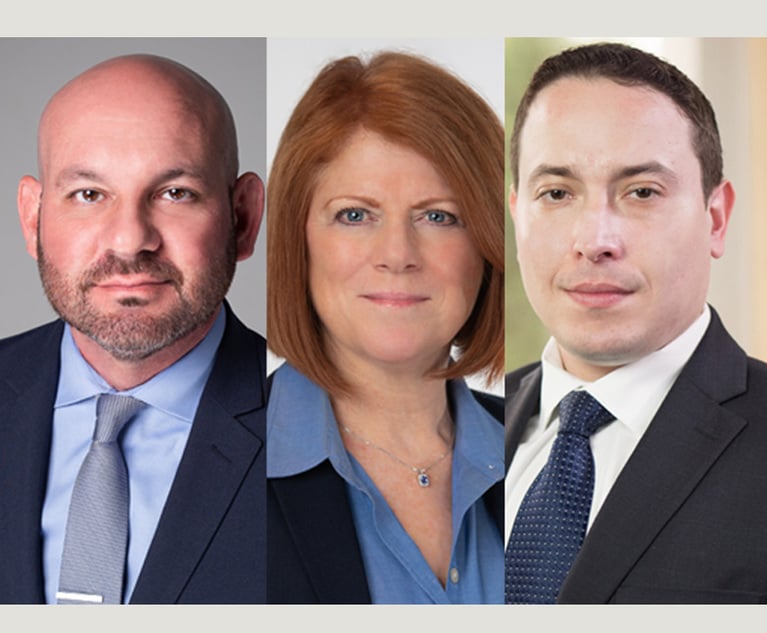
David Frederick, a partner at Kellogg, Huber, Hansen, Todd, Evans & Figel who trounced Wyeth in a drug pre-emption case last year, will argue against Wyeth again in the Bruesewitz case. He'll face off against former Stanford Law School dean Kathleen Sullivan, now name partner and head of the appellate practice at Quinn Emanuel Urquhart & Sullivan.
If Wyeth wins, then more than 5,000 families making autism-related vaccine claims may not be allowed to sue vaccine makers in tort actions after they are adjudicated under the so-called "vaccine court" system Congress devised in 1986.
In part to keep vaccine manufacturers from leaving the field, Congress established a special system for compensating vaccine injuries. The cases are handled by the claims court in an expedited, no-fault process. Claims are made against the government, not vaccine makers. To a limited degree, the law left the door open to taking cases to court after losing in the claims system, and the high court will decide when that can happen.
If Wyeth loses, then parents may find a more sympathetic state-court forum for their claims than the one Congress created. "The system hasn't worked the way it was supposed to work at all," said New York University School of Law professor Mary Holland, who has written legal briefs on the side of parents in autism cases. "Through the Bruesewitz case, the Supreme Court will find out the program is a disaster."
Cedillo agreed. "It wasn't supposed to be adversarial; it was supposed to be quick and family-friendly," she said. "It has been none of those things. The Supreme Court case could give us another option."
Cedillo's daughter was born healthy in 1994 but, a week after receiving the standard measles-mumps-rubella vaccine in 1995, she ran high fevers and her development slowed. In 1997, she was diagnosed with autism. Now 15, Michelle requires constant monitoring because of frequent and life-threatening seizures, according to her mother -- and her case is still pending. "It's really sad."
The Cedillo family volunteered to be the first "test case" of one of the theories of causation linking the vaccine to autism. After a three-week hearing and the testimony of 17 witnesses against her, a special master last year dismissed the claims, asserting the evidence was "overwhelmingly contrary" to the claim that vaccines containing mercury caused Michelle's disabilities.
Last month, Ronald Homer of Conway, Homer & Chin-Caplan in Boston challenged the ruling in the U.S. Court of Appeals for the Federal Circuit. He claimed the system is biased because the government fears that linking autism to vaccines will scare parents away from having their kids vaccinated. "She was denied compensation because she was a messenger," Homer wrote.
A second test case in which a family lost, Hazlehurst v. HHS, is also on appeal at the Federal Circuit.
For its part, the government claims that Cedillo had six expert witnesses of her own. In a brief filed in the Cedillo case, Justice Department lawyer Lynn Ricciardella said the special master's decision "reflects a careful and well-reasoned analysis."


Reader Comments