New York University is entitled to recover legal fees for battling to preserve the remaining assets of a hedge fund from which a prominent New York financier pumped hundreds of millions of dollars into Bernard Madoff's Ponzi scheme, a Supreme Court justice in Manhattan ruled last week.
Justice Richard B. Lowe III found, over the opposition of the New York attorney general's office, that the benefit NYU conferred on investors in the $1.3 billion Ariel Fund was "of such a great measure" that it would be "inequitable" not to compensate its attorneys.
NYU, which had invested millions of dollars in the Ariel Fund, which was managed by J. Ezra Merkin, filed suit to recover its losses on Dec. 23, 2008, less than two weeks after news of the Madoff scandal broke on Dec. 11.
Merkin disclosed that on Dec. 11, the day Madoff was arrested, Merkin had turned over some of his investors' funds to Madoff to manage.
NYU agreed to bow out of the litigation four months later when the attorney general's office sued to recover an estimated $1.2 billion that Merkin's investors allegedly lost because he had funneled money to Madoff from three of his hedge funds, including Ariel.
NYU subsequently asked Lowe to award it approximately $1 million in fees for work it had done in its case, New York University v. Ariel Fund, 603803/08, prior to the state entering the case.
But the attorney general's office, citing the need to protect the assets remaining in the Ariel fund, opposed the motion, contending that such an award would be taken from assets that otherwise could be distributed to "hundreds of other investors" whose interests it is protecting in its lawsuit.
According to the complaint the attorney general filed on April 6, 2009, in People v. Merkin, 450879/09, Ariel had funds from 78 investors worth $1.3 billion under its management as of Sept. 30, 2008. NYU owned about 10 percent of the fund, according to its complaint.
As of that date, Merkin's Gabriel fund had $1.4 billion under its management from close to 200 investors, and the Ascot fund held $1.7 billion from more than 300 investors.
Merkin had formed the Ascot fund as a "feeder" for investment with Madoff and "virtually all of its assets had been placed with Madoff," according to the attorney general's complaint. In contrast about one-third of the funds invested in Ariel and Gabriel had been placed with Madoff.
Reviewing the work performed by NYU's legal team, Justice Lowe concluded the university had "without question" conferred "a substantial benefit on Ariel."
Most importantly, he found that NYU had obtained a temporary restraining order when it commenced its lawsuit that barred Merkin from removing or encumbering any of "approximately $1 billion in assets" held by Ariel, which is incorporated in the Cayman Islands.
The restraining order that Lowe had issued at NYU's request also barred Merkin from collecting the $323 million in incentive fees he claims he is owed for managing Ariel. According to an economist retained by NYU, about $146 million of the claimed incentive fees is attributable to fictitious profits generated by Madoff, who is serving a 150-year prison term after pleading guilty to the charges against him.
"No one, other than NYU" took steps to preserve Ariel's assets after news of the Madoff scandal broke, Lowe wrote.
"It took the AG, whom investors relied upon, approximately five months" to file suit after Merkin first revealed he had turned over his investors' assets to Madoff, Lowe wrote. "It took NYU less than two weeks."
Lowe also noted that NYU had assumed the financial risk of seeking a restraining order by agreeing to post a $10 million bond.
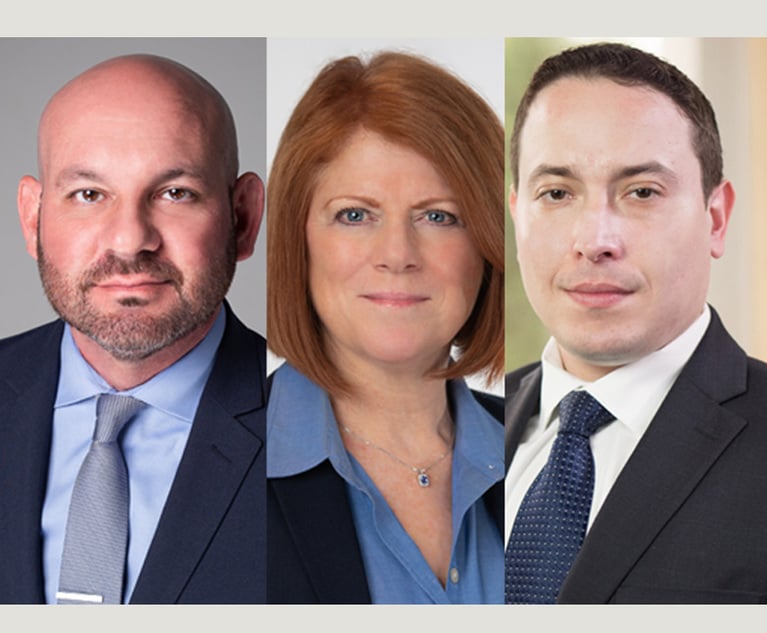
The judge had kind words for NYU's team of lawyers from Scott & Scott, led by partner Beth Kaswan.
Calling their work "superb," he wrote, they "demonstrated a remarkable grasp and handling of the extraordinarily complex matters in this case."
He referred to a special referee the question of the amount of fees to be awarded. In its motion papers, NYU pegged the value of Scott & Scott's services at approximately $1 million.
David A. Markowitz, who is now the special deputy attorney general for investor protection, represented the state.
Assisting Kaswan on the fee motion were Judith Scolnick and Joseph Guglielmo, also of Scott & Scott.
Bart M. Schwartz, the receiver appointed by Lowe to manage the Ariel fund, also opposed NYU's fee request. He was represented by James C. McCarroll, of Reed Smith.
For more coverage of the Bernard Madoff case, see the Law.com Madoff Watch page.
For continuous updates, follow Law.com's Madoff Watch on Twitter.