Kasowitz, Benson, Torres & Friedman has sued its longtime client Duane Reade Inc. for a $7 million "success fee" it claims it is owed as part of an alternative fee arrangement. (See the complaint.)
The Manhattan-based law firm represented Duane Reade in a contract dispute with Cardtronics LP, an ATM operator. But when the drugstore chain switched general counsel in 2008, it settled the dispute for an estimated $39.5 million without the law firm's knowledge. Kasowitz claims in court papers that the settlement included terms negotiated by the firm during the course of the litigation, and that it is owed a 20 percent share of the settlement under its alternative fee agreement.
A spokeswoman for Duane Reade declined comment. Mitchell Schrage, a partner at Kasowitz representing the firm, also declined comment.
The lawsuit, Kasowitz, Benson, Torres & Friedman v. Duane Reade, 101547/2010, filed Feb. 4 in Manhattan Supreme Court, comes at a time when clients are increasingly pushing law firms to enter into non-hourly fee arrangements. A survey of in-house counsel released in October by Fulbright & Jaworski found that 45 percent of companies use some form of alternative fee arrangement. The 100 largest U.S. law firms by revenue in 2008 earned roughly $7 billion from alternative fee arrangements, or an average of 11 percent of their overall gross, according to a survey released in January by consulting firm LegalBizDev.
"Clients generally benefit from that sort of thing," said Ward Bower, a consultant at Altman Weil Inc.
But with the growth of alternative fees comes also the potential for disagreements over exactly how much is owed to the firm, said Mark Zauderer, a partner at Flemming Zulack Williamson Zauderer who is currently representing a law firm in litigation over a contingency fee.
"These have the potential for dispute because they're not as simple as contingency fee or time-based fee arrangements," Zauderer said.
Kasowitz partners bill $550 to $1,000 an hour, according to a June 2009 bankruptcy court filing. But at the request of Duane Reade, Kasowitz said in its court papers that it agreed to bill on a modified fee arrangement. Under the deal, Kasowitz would earn a $1 million flat fee over a period of time. In exchange for the reduced billings, Kasowitz stood to earn a "success fee" of 20 percent for any value the company received that exceeded $4 million.
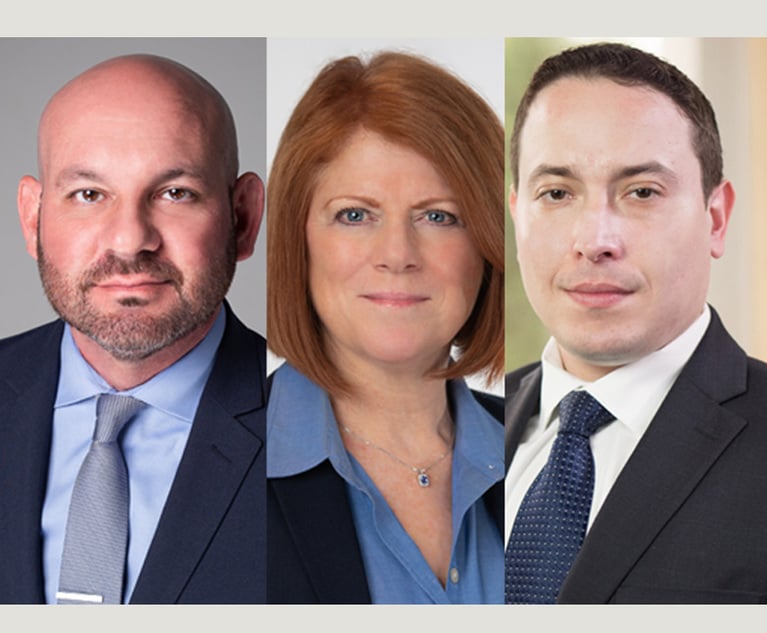
The fee was negotiated between Duane Reade's general counsel at the time, Michelle Bergman, and Daniel Goldberg, a Kasowitz commercial litigator who joined the firm with two other partners from White & Case in March 2006. Goldberg and Bergman had a long-standing attorney-client relationship, the Kasowitz complaint said. Bergman joined Duane Reade in July 2002.
In June 2006, Goldberg filed a complaint for Duane Reade against Cardtronics LP in the Southern District of New York. The case was later moved to Manhattan Supreme Court, Duane Reade v. Cardtronics, LP, 603545-2006.
Cardtronics had installed or upgraded ATMs in more than 250 Duane Reade stores. JPMorgan Chase was chosen as a "branding bank," whose name would be featured on the machines and Chase customers would not be charged a fee for using the ATMs.
Duane Reade claimed in its suit that Cardtronics was required to compensate the drugstore chain for the revenue lost by allowing Chase customers free use of the machines, but that in June 2005, Cardtronics stopped paying the proper amount. Duane Reade in its court papers claimed it was owed no less than $600,000 in lost surcharge revenue, and an additional $100,000 for each month going forward. As the agreement with Duane Reade was to last through December 2014, Cardtronics estimated in a May 2009 quarterly filing that the claims could have exceeded $12 million.
Kasowitz, which conducted mediation and settlement negotiations on behalf of Duane Reade, said that terms negotiated in May 2007 were included in the final settlement, namely, increasing fees for use of the ATM and canceling the agreement with Cardtronics altogether so the company could retain a different provider.
Cardtronics, represented by Steven Paradise at Vinson & Elkins, in September 2007 won summary judgment, but Duane Reade appealed, and in August 2008, the New York Supreme Court, Appellate Division, 1st Department, remanded the case. The dispute finally settled.
PAYMENT TO KASOWITZ
During the course of the litigation, Duane Reade followed through in part on the flat-fee aspect of its agreement with Kasowitz, paying the firm $100,000 a month.
In November 2008, Bergman resigned as Duane Reade's general counsel and was replaced by Phillip Bradley.
Kasowitz said in its fee suit that Duane Reade settled the Cardtronics litigation without the firm's knowledge in February 2009.
Cardtronics, in its August 2009 quarterly report, said the final settlement was entered May 2009. Goldberg, along with Paradise at Vinson, filed the motion of discontinuance that month.
Nevertheless, Kasowitz in its complaint asserted that the settlement "achieved the goals Duane Reade hired [Kasowitz] expressly to achieve ... including those pursued at the May 2007 mediation." Cardtronics agreed to pay Duane Reade in cash, increase the surcharge fees, and terminate the agreement by November 2009 so Duane Reade could enter a more lucrative deal directly with JPMorgan Chase, according to Kasowitz's court papers and Cardtronics' August 2009 quarterly report.
Cardtronics also said it made a termination payment to Duane Reade.
Kasowitz claims in court papers that the increased customer fees would result in Duane Reade realizing more than $39.5 million from the Cardtronics litigation. At 20 percent, the success fee agreement would equal at least $7.1 million.
Kasowitz in 2008 earned $221 million, according to affiliate publication The American Lawyer, with profits per partner of $2.2 million.
The firm claims in its suit that Duane Reade refuses to pay the fee. Notably, Kasowitz in the complaint said Bergman "has attested under oath" to the fee agreement's existence and the goals Duane Reade had pursued in the litigation.
It was not clear when or where Bergman gave that testimony. Bergman, who joined the White Plains, N.Y., office of Columbus, Ohio-based law firm Benesch as of counsel in January, declined comment.