During arguments at the Supreme Court Tuesday in a water dispute that came to the Court under its "original jurisdiction" over conflicts between states, discussion of the issues led the justices into some broader questions about the nature of original jurisdiction cases and the role of special masters appointed by the Court to assist in their adjudication.
Chief Justice John Roberts Jr. seemed especially protective of the Court's role in such matters, returning a number of times to the idea that they are a unique and important subset of the Court's cases. At one point during the argument he expressed concern that if non-state entities are allowed to intervene in the cases, "private parties are going to hijack our original jurisdiction."
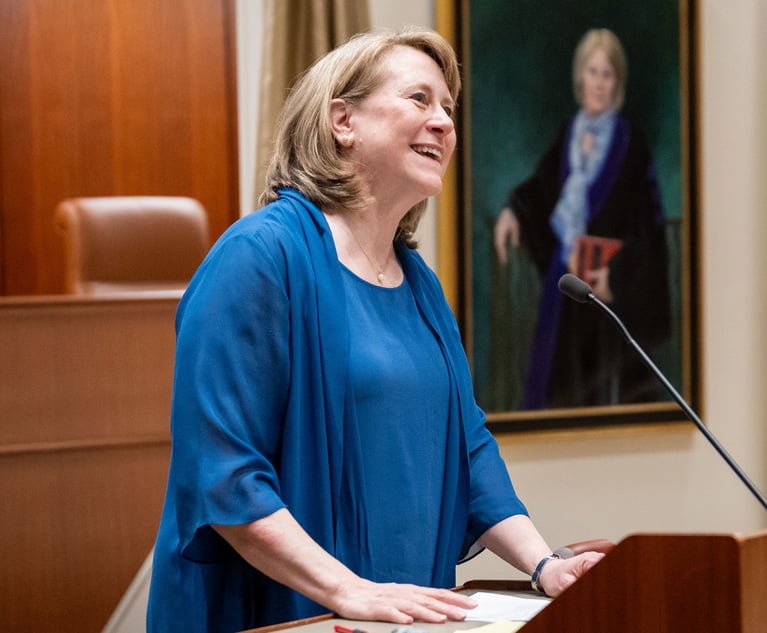
The case, South Carolina v. North Carolina, involves a dispute over the apportionment of water from the Catawba River, which flows between the two states. The issue before the justices is whether three non-state parties may join as interveners in the case. The special master appointed by the Court to oversee fact-finding in the case, Munger, Tolles & Olson partner Kristin Linsley Myles, recommended that the parties be allowed to intervene. South Carolina, supported by the U.S. Solicitor General's office, appealed Myles' recommendation.
Debated throughout the argument hour was the level of deference the Court should apply to the recommendations of special masters in original jurisdiction cases, which come directly to the Court without lower court review. Justice Ruth Bader Ginsburg asked whether the "rule of permissive intervention" in ordinary civil cases would be an appropriate standard to apply to original jurisdiction cases as well.
"So even though the civil rules are not binding in original jurisdiction cases, isn't that a sound approach that we should adopt?" she asked Kellogg, Huber, Hansen, Todd, Evans & Figel partner David C. Frederick, who argued on behalf of plaintiff South Carolina. "Just as a court of appeals would defer to a district judge's decision, so we should give a healthy measure of deference to the special master's evaluation that this will be useful?"
Frederick argued that the justices should instead apply a de novo review standard in evaluating the legal test used by the special master to decide the intervention issue. Though the Court gives "appropriate respect" to special masters, Frederick said, "there would be no basis for applying a deference standard to a special master ruling on a question of law that fundamentally is about what this Court's original jurisdiction under Article 3 is supposed to be about."
Roberts appeared to be receptive to that argument, and took it up with Hogan & Hartson's H. Christopher Bartolomucci as soon as he took the podium on behalf of the prospective interveners. Bartolomucci urged the justices to defer to the special master on the intervention issue because "she is in the best position to know whether these parties would assist her in the adjudication of this complex dispute."
"This is our original jurisdiction," Roberts said emphatically. "I regard the special master as more akin to a law clerk than a district judge. We don't defer to somebody who's an aide that we have assigned to help us gather things here."
Several justices questioned whether the potential interveners -- Duke Energy Carolinas, the city of Charlotte, N.C., and the Catawba River Supply Project, all major users of water from the river -- met the standard of possessing a compelling interest in the case that is not adequately represented by the state parties. Ginsburg asked what level of interest would justify intervention, "where, obviously, we are not going to allow all users of the river water to come in, so which ones can and which ones can't?"
Roberts offered a hypothetical related to this issue: "Let's say I owned a little farm on the banks of the Catawba, and I take water out ... so the cows have something to drink. Why does Charlotte get a special status just because they take a lot?" Why wouldn't a small-farm owner also have a compelling interest, Roberts asked. "In times of drought, this water barely trickles by, and, if it's cut back, the farm's going to go down. It seems to me that, when you say they have a special interest, you are just saying they have got a big interest."
Some of the justices discussed whether a more appropriate role for the non-state entities would be as amici in the dispute. Justice Sonia Sotomayor asked Bartolomucci why their intervention as parties would be more helpful to the case: "What can they provide that couldn't be done by merely an amici submission?"
Ginsburg took up this point as well: "Coming in as interveners, they have full party status. They can engage in discovery. They can protract the case. They can appeal any adverse judgment. Why isn't the most reasonable accommodation to say, well, we will listen to you, but we are not going to give you full party status?"
Ginsburg, like Roberts, seemed concerned that non-state intervention might run counter to the traditional posture and purpose of original jurisdiction cases.
A state "can't be sued without its consent," Ginsburg said. "And it's true here that South Carolina is initiating the action, but it's initiating the action against a sister state. The special master's recommendation would require the state to have as its direct adversary three parties who are not a sister state, and that kind of dilutes the notion of original jurisdiction. It's a controversy between two states."
Laurel Newby is a senior editor with Law.com.