Incisive Media's Law.com
  • Law.com Network
  • Legal Web
Register for Law.com Newswire
Newsletters
RSS

Law.com Home > Justice Thomas on Rights, Law School and Tough Cases

Font Size: increase font decrease font

Justice Thomas on Rights, Law School and Tough Cases

Supreme Court justice touched on familiar themes of responsibility and self-reliance in speech to students

Tony Mauro

Legal Times

April 03, 2009

  • deliciousdel.icio.us
  • digg Digg
  • redditReddit
  • facebookFacebook
  • googleGoogle Bookmarks
  • newsvineNewsvine
  • linkedinLinkedIn
  • mixxMixx
  • stumbleuponStumbleupon
  • twitterTwitter
  • Print
  • Share
  • Email
  • Reprints & Permissions
  • Post a Comment
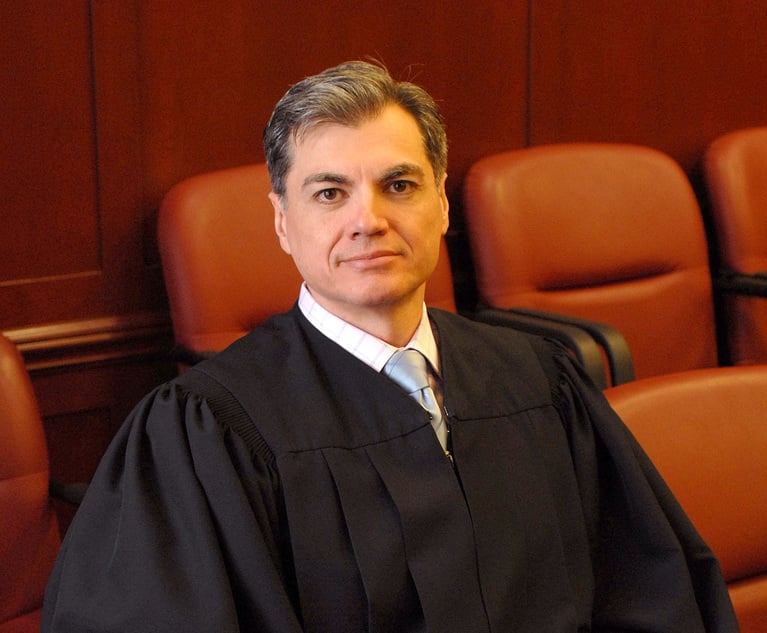
Supreme Court Justice Clarence Thomas

Supreme Court Justice Clarence Thomas
Image: Diego M. Radzinschi/Legal Times

If you've ever seen Supreme Court Justice Clarence Thomas speak to a group of students, you know how energized and enthusiastic he becomes.

That was the case Tuesday night when Thomas served as the keynote speaker for an event celebrating the 27 winners of a nationwide high school essay contest. The contest is sponsored by the Arlington, Va.-based Bill of Rights Institute, a 10-year-old organization that develops programs and curricula for high schools on the nation's founding documents.

The contest has become the largest in the country, says institute founder Victoria Hughes. This year it drew 31,000 entries.

"This is the good part of the job," said Thomas to the friendly crowd at a downtown hotel. Fox News and NPR commentator Juan Williams -- who wrote one of the first stories about Thomas when he came to Washington, D.C., nearly 30 years ago -- was the master of ceremonies, and Fox legal commentator Andrew Napolitano read students' questions to Thomas, along with Brian Jones, former general counsel of the U.S. Department of Education.

Thomas touched on familiar themes of responsibility and self-reliance. In the current economic crisis, Thomas said it is remarkable how many people think that "each of us is owed prosperity and a certain standard of living." But his own upbringing taught him that prosperity is not a constant, and he recalled a time when "air conditioning was the ultimate luxury." Laughing, he added, "I'm one of those who still thinks the dishwasher is a miracle," which he said explains why "I like to load it" at home.

Likewise, Thomas said the proliferation of taken-for-granted rights has led to the "virtual nobility that seems to be accorded those with grievances ... . Shouldn't there at least be equal time for our bill of obligations, our bill of responsibilities?" Thomas did say that rights were important, and he extolled the 14th Amendment as the source of many of them.

Asked how his judicial philosophy has changed since his law school days at Yale, Thomas laughed that "I didn't have one," because he was too busy trying to get through his classes. "In law school, you don't know a lot," he said. "You learn about due process, you try to figure out what emanations from penumbras are, you take your torts class, your UCC class." His judicial philosophy now, he said, is "to try to discern the intent of the framers ... and try to keep my personal views out of it."

On that subject, Thomas said that as a justice, "there are some tough cases ... some cases that drive you to your knees." Early in his tenure in 1992, he recalled, he faced the case of Haitian refugees that the government wanted to send back to Haiti. "I thought these people should have an opportunity to come into this country." But the law did not give him power to accomplish that, he said. "That wasn't a decision for me as a judge ... . It was enormously difficult to balance that limitation with what I wanted to do."

Footnote: During the talk Thomas thanked and praised his wife Virginia, who was in the audience, and he referred to her job with Hillsdale College -- which may come as a surprise to those who recall her longtime position with the conservative Heritage Foundation. Last fall Mrs. Thomas left Heritage to become associate vice president for Washington, D.C., operations with the Michigan college.

Hillsdale, which prides itself on not taking any federal money, launched a D.C. center for constitutional studies and citizenship in November. In a Washington Times interview in December, Mrs. Thomas said the new job was "my way of pulling away from politics," and she said the college position was the "safest place to be when it comes to conflicts" with her husband's job.

First reported in The BLT: The Blog of Legal Times.


Subscribe to Legal Times

  • Print
  • Share
  • Email
  • Reprints & Permissions
  • Post a Comment

Advertisement

Top Stories From Law.com

Legal Technology

  • LegalTech New York: That's a Wrap

Corporate Counsel

  • This Boot's for You: Former Amkor Technology General Counsel Disbarred

Small Firm Business

  • Wealth Management Group Leaving Wilson for Regional Firm

Advertisement

lawjobs.com

TOP JOBS

MORE JOBS >>

POST A JOB >>

Advertisement

About ALM  |  About Law.com  |  Customer Support  |  Reprints  |  Privacy Policy  |  Terms & Conditions
Close [ X ]