Font Size:
![]()
Solicitor General Nominee Kagan Faces the Senate
Legal Times
February 11, 2009
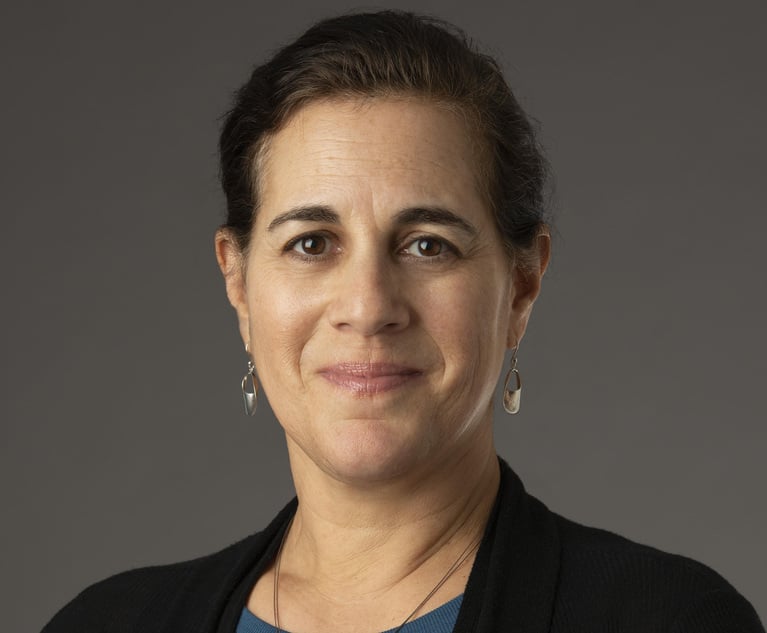
Elena Kagan, dean of the Harvard Law School.
Solicitor General nominee Elena Kagan resisted any suggestion Tuesday that she would make dramatic changes in the federal government's advocacy before the Supreme Court, declining to criticize legal arguments made by the Bush administration and telling members of the Senate Judiciary Committee that she is prepared to defend almost any law Congress passes.
Kagan, dean of Harvard Law School, appeared before the committee for a two-hour confirmation hearing amid widespread speculation that she might be nominated to the Court if a seat were to become vacant. Two Republican senators even brought up the appointment and confirmation process for federal judges, leading Kagan to say that she no longer believes nominees should give their views on potential cases.
The hearing also included Associate Attorney General nominee Thomas Perrelli, managing partner of Jenner & Block's Washington, D.C., office, but senators directed more of their attention at Kagan. They asked her about her academic writings, her clerkship for Justice Thurgood Marshall, her lack of appellate experience, and how she would decide the government's legal positions.
Sen. Orrin Hatch, R-Utah, referenced a 1993 decision by the Clinton administration that reinterpreted the definition of child pornography, causing the Supreme Court to vacate a conviction in a case known as Knox v. United States. "I do not want a solicitor general who will use that office to change the law through the courts," Hatch said.
Though Kagan said she was not familiar with the details of the case, she pledged to begin with the presumption that the solicitor general is obligated to defend laws even if the Obama administration opposes them. "I would have no difficulty in this area whatsoever. I would have no difficulty in any area defending a statute," she said.
Sen. Tom Coburn, R-Okla., raised the issue separately, asking how Kagan would respond in a case where a law had been undermined by a president's executive order. "The obligation to defend a statute carries on," Kagan replied. "It would not appear to me that an EO would call into question the legal basis of a statute."
The only laws that a solicitor general should not defend, she said, are those where there is no reasonable basis to do so and those that infringe directly on the power of the president. The second category is "exceedingly narrow," she added.
Kagan's answers did not always please the Democrats on the committee. Sen. Dianne Feinstein, D-Calif., suggested to Kagan that the Solicitor General's Office made a mistake in 2006 by defending the Environmental Protection Agency's position that it did not have the authority to regulate carbon dioxide and other emissions that contribute to global warming.
"The solicitor general has to defend executive actions to the best of her ability," Kagan replied. Feinstein said such a standard would mean that "whatever the agencies want, the agencies will get." Feinstein added, "There are many of us -- I happen to be one -- who thought that the EPA was very politicized in the last administration."
In response to a question from Sen. Jon Kyl, R-Ariz., Kagan also declined to criticize the Solicitor General's Office for its position in Rumsfeld v. FAIR. In that case, the Court unanimously ruled in 2006 that Congress has the authority to require access for military recruiters at universities that receive federal funds; Kagan had joined a brief with other Harvard professors arguing that universities could restrict access because of the military's ban on gays and lesbians serving openly.
Kyl, a member of the Supreme Court bar since 1971, spoke at length about the importance of experience in appellate advocacy, noting that Kagan has none. "There is an advocacy ability that comes not just from academic knowledge but by doing it," he said.
Kagan responded that she brings other experiences, as a teacher, administrator and scholar skilled in a direct way of communicating. She also said she's willing to learn. "I'm going to make a very intensive study of what I might be missing when I come to the job," she said.
Congress has a recess scheduled for the week of Feb. 16, potentially pushing committee votes on the Kagan and Perrelli nominations to the week of Feb. 23 or later. The committee must also vote on the nomination of David Ogden, a partner at Wilmer Cutler Pickering Hale and Dorr, to be deputy attorney general.