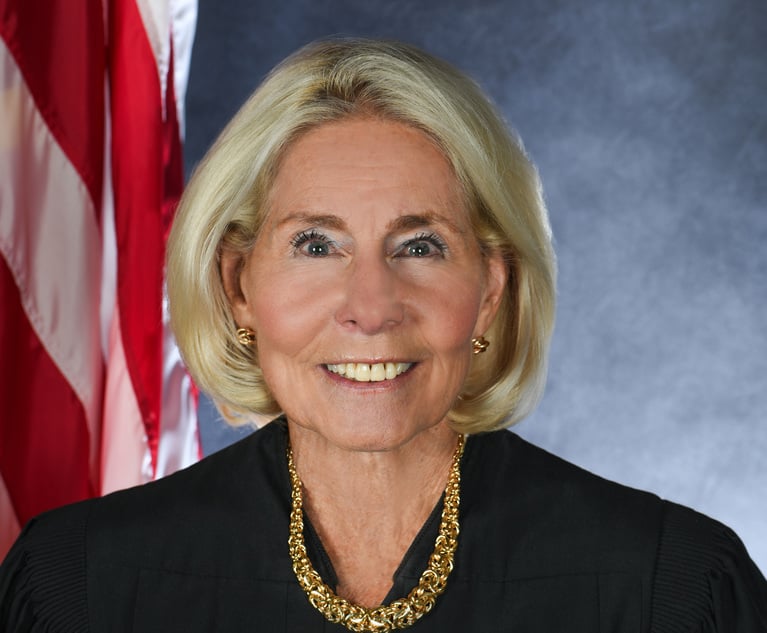
U.S. Supreme Court Justice Ruth Bader Ginsburg
image: Patrice Gilbert/Legal Times
Justice Ruth Bader Ginsburg underwent surgery in New York City on Thursday to treat early-stage pancreatic cancer, the Supreme Court announced. The 75-year-old justice is expected to remain at Memorial Sloan-Kettering Cancer Center for seven to 10 days.
A press release from the Court issued Thursday afternoon indicated a tumor in her pancreas was discovered during a routine annual checkup in late January at the National Institutes of Health in Bethesda, Md. The announcement offered no assessment of the success of the surgery or future treatments. The Court is on a long recess, not returning to the bench until Feb. 23.
In 2008, according to the National Cancer Institute, 37,680 people in the United States were diagnosed with pancreatic cancer, and 34,290 people died of the disease. Surgical removal of the tumor at an early stage is a good sign for treatment, but the Mayo Clinic Web site states, "Pancreatic cancer often has a poor prognosis, even when diagnosed early." Ginsburg recovered quickly from colorectal cancer in 1999.
See video of Legal Times Supreme Court correspondent Tony Mauro discussing Justice Ginsburg's surgery and the Court's history of grappling with justices' health issues.
The news of Ginsburg's new illness stirred talk of a departure from the bench for the liberal justice, who was appointed to the high court in 1993 by President Bill Clinton. But those who know Ginsburg say it is far too early to make such predictions.
"God willing, I think she will continue to stay on the Court as long as she can," said Latham & Watkins associate Lori Alvino McGill, who clerked for Ginsburg in 2006. "I don't think this will shake her resolve."
Especially since the election of Barack Obama as president, speculation has increased that Ginsburg, along with other liberal-moderate justices John Paul Stevens and David Souter, might be ready to leave the Court, confident they will be replaced by like-minded justices.
But several people who attended her law clerks' reunion last summer quoted Ginsburg as saying that anyone who asks should be told she had no intention of leaving soon. In a speech at Columbia University last October, she dropped another hint about her plans to stay.
Ginsburg said in the speech that the late Justice Louis Brandeis "became a justice at age 60, as I did. He remained on the bench until age 83. My hope and expectation is to hold my office at least that long." To match Brandeis' tenure, she would have to remain on the Court until 2016.
Ginsburg was a judge on the U.S. Court of Appeals for the D.C. Circuit when Clinton named her to replace Justice Byron White. Clinton said he picked her in part because of her longtime advocacy for women's rights as an American Civil Liberties Union attorney, describing her as the Thurgood Marshall of the women's rights movement.
On the Court, as she was on the D.C. Circuit, Ginsburg has usually been a more moderate voice than some expected. She is the second woman on the Court, and when the first woman, Justice Sandra Day O'Connor, retired in 2006, Ginsburg said she felt lonely without her. O'Connor, herself a breast cancer survivor, helped Ginsburg through her time with colorectal cancer.
In a 2007 interview with Legal Times, Ginsburg said, "There is nothing that carried me through the year that I had cancer as [much as] being on this Court, and saying to myself, ‘You have a sitting coming up; don't let this occupy your time. You have something to do.' "
In a 2001 speech at Washington Hospital Center, where she had been treated, Ginsburg said, "Cancer is a dreadful disease." But with caring medical staff and honest reports from her doctors, she said she was able to get through it.
"Knowing what to expect, I was able to schedule therapy to fit the Court's calendar and missed no sittings that term," Ginsburg said. "Work, I found, was the best balm." Ginsburg's husband, Martin, a Georgetown University Law Center professor, is a 50-year survivor of testicular cancer.
"There is nothing like a cancer bout to make one relish the joys of being alive," Ginsburg said during the talk. "Each thing I do comes with a heightened appreciation that I am able to do it."