Font Size:
![]()
Counsel Asks N.Y. High Court Not to Suspend Surrogate-Elect Over Campaign Contributions
New York Law Journal
December 23, 2008
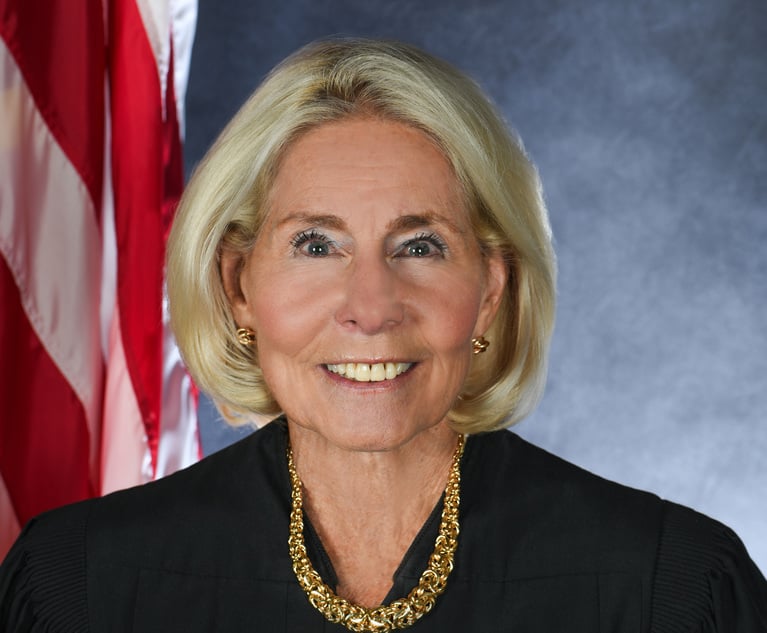
Nora S. Anderson should be allowed to become Manhattan surrogate on Jan. 1, even as the Manhattan district attorney prosecutes her on felony charges of concealing improper political contributions during her campaign for the bench earlier this year, her attorney has told the Court of Appeals.
And if the court decides to suspend Anderson, it should do so with pay because she is supporting an ill mother and brother, and the surrogate-elect will be prohibited from practicing law when her term begins on Jan. 1, the attorney, Richard Godosky, urged in a letter to the court (pdf).
The court is determining Anderson's status as surrogate following her Dec. 10 arraignment on a 10-count indictment of falsely reporting that $250,000 that poured into her campaign coffers before the September primary was her own money. Prosecutors contend the money came from attorney Seth Rubenstein, for whom Anderson has worked for nearly a decade.
"Ms. Anderson's indictment ... does not charge Ms. Anderson with acts of venality or corruption, but violations of the campaign finance provisions of the Election Law either as misdemeanors under the Election Law or generic felonies under the Penal Law based on the Election Law misdemeanors," Godosky wrote. "Obviously, because she has yet to take the Bench, the conduct with which Ms. Anderson is charged has nothing to do with her conduct or fitness as a judge."
Godosky cited Matter of Cornelius, 48 NY2d 1014 (1980), as supporting his view that suspension of a judge is not merited in every instance where the judge is charged with a felony. In Cornelius, a 5-2 court ruled against suspending a Family Court judge from Monroe County who faced a felony for offering testimony while a prosecutor which he had been advised was false.
Robert H. Tembeckjian, administrator of the state Commission on Judicial Conduct, argued in his letter to the court (pdf) that suspension is the customary course the court has taken when judges have been charged with felonies. Doing so balances the "presumption of innocence to which the accused is entitled at trial with the need for public confidence in the integrity of the judiciary, the courts and the administration of justice," Tembeckjian wrote.
"The Commission believes that public confidence in the integrity of the judiciary, the courts and the administration of justice would be undermined were Ms. Anderson to exercise the powers of judicial office in one court while contemporaneously defending against felony charges pending against her in another," Tembeckjian opined.
The commission advised the Court of Appeals it could find no other instance since the current constitutional and statutory provisions giving the court the authority to decide the status of judges went into effect in 1978 when an individual not holding judicial or other public office was charged with a felony between the election and when the individual was to take office.
Tembeckjian said the commission was taking no position on whether Anderson should be paid if she is suspended.
Godosky criticized Tembeckjian for not citing Matter of Cornelius in his letter to the court.
Tembeckjian said it was an oversight.
The court is expected to make a determination on Anderson's judicial status as of Jan. 1 based on the submissions.
Both Anderson and Rubenstein have been free on their own recognizance since being arraigned on the charges before Acting Supreme Court Justice Bruce Allen of Manhattan. Both face a maximum prison term of 1 1/3 to four years if convicted of the top six counts of the indictment, all Class E felonies.
When announcing the indictments earlier this month, District Attorney Robert M. Morgenthau contended Anderson found herself short of money in the waning days of the Democratic primary in September. Rubenstein is accused of making payments of $100,000 and $150,000 from his own accounts to Anderson's personal accounts, with Anderson allegedly donating the money or lending it to her campaign fund.
By law, the maximum Rubenstein could contribute to Anderson's primary was $33,122, Morgenthau said.
Anderson won a three-way race against John J. Reddy, counsel to the public administrator, and Manhattan Justice Milton A. Tingling by capturing 48 percent of the 55,000 votes cast. She ran unopposed in the general election.
The Manhattan surrogate makes $136,700 a year.
If Anderson is suspended, Chief Administrative Judge Ann Pfau could assign another judge to fill in until her case is resolved.
Godosky, of Godosky & Genile, is representing Anderson in the suspension matter. Gustave H. Newman of Newman & Greenberg is her trial counsel.
"She fully expects to be vindicated, whether on pretrial motion or after trial," Godosky told the court.
Stuart M. Cohen, clerk of the court, invited both Anderson and the commission to offer their views to the court as it considers whether Anderson should be suspended.