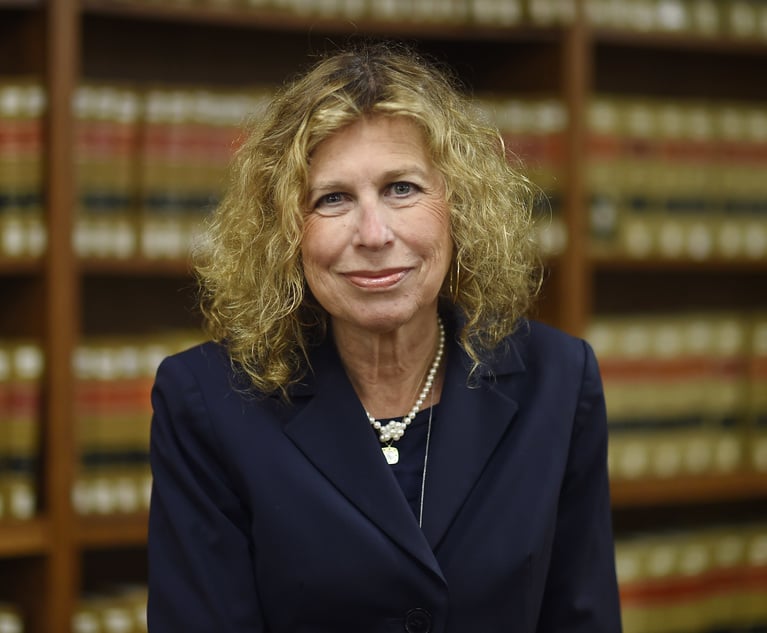
Nora S. Anderson, 56, who is scheduled to become Manhattan surrogate on Jan. 1, pleaded not guilty Wednesday to charges that she falsely reported $250,000 pumped into her campaign as her own money when in fact the funds came from Seth Rubenstein, the lawyer in whose office she has worked for the last nine years. (See the indictment.)
Rubenstein, 81, a well known trust and estates lawyer based in Brooklyn, likewise pleaded not guilty to the same charges of making contributions above campaign spending limits and concealing the source of the contributions.
With the consent of the prosecution, Acting Supreme Court Justice Bruce Allen released both defendants on their own recognizance.
Both Anderson and Rubenstein were charged in a 10-count indictment and face a maximum prison term of 1 1/3 to four years if convicted of any of the top six counts, all Class E felonies.
Manhattan District Attorney Robert M. Morgenthau said the "crux of the case" is that the two sought to evade campaign spending limits that apply to Rubenstein as a contributor but not to Anderson as the candidate by making it appear that his contributions had in fact come from her.
Before her arraignment Wednesday a grim-faced Anderson was led toward the courtroom on the 11th floor of the Criminal Court building at 100 Centre St. with her hands cuffed behind her.
Looking haggard and shell-shocked, Rubenstein, who wore his long, white hair in a pony tail, also was led toward the courtroom in handcuffs.
Both defendants were taken out of the public hallway into the courtroom through a side entrance. They remained handcuffed until their case was called, the first on Wednesday's afternoon calendar in Part 1.
At the outset of the brief proceeding, Anderson's lawyer, Gustave H. Newman, asked that the handcuffs be removed, and they were.
Outside the courtroom, Newman disparaged the charges, saying they arose from an election law "about which even election lawyers have disagreements."
Newman added that when all the facts are in, "it will be clear that Ms. Anderson is innocent of any wrongdoing and her unblemished reputation will be restored."
Rubenstein's lawyer, Frederick P. Hafetz, said his client had "acted totally within the election law, and we are confident he will be vindicated at trial."
Neither Anderson nor Rubenstein answered questions directed to them by reporters. Within the courtroom, their only comment was "not guilty" to the charges against them.
TWO PAYMENTS AT ISSUE
In the indictment filed Monday, Rubenstein is accused of making two payments in August, one for $100,000 and one for $150,000 from his accounts to Anderson's personal accounts. Within days of the first Rubenstein deposit, Anderson contributed $100,000 to her campaign. On the same day as the second deposit, she loaned her campaign $150,000.
The two payments were made at a time, Morgenthau said, when Anderson's campaign for the Democratic Party nomination in the Sept. 9 primary "was running low on money and did not have sufficient funds to pay for the printing and mailing of campaign materials or to pay people to work on election day."
The maximum Rubenstein could have contributed to Anderson's primary campaign was $33,122, Morgenthau said.
The district attorney quipped that Anderson "should have been running in Chicago maybe," a reference to the charges unveiled against Democratic Illinois Gov. Rod R. Blagojevich, who is accused of trying to auction off his appointment to fill President-elect Barack Obama's U.S. Senate seat.
Both Anderson and Rubenstein are accused of four counts of filing a false instrument in the first degree and two counts of falsifying business records in the first degree, all Class E felonies. They also are accused of two counts of violating a requirement that campaign contributions be made under the true name of the donor and two counts of willfully violating contribution limits, all misdemeanors punishable by up to one year in prison.
Daniel Castleman, chief assistant district attorney, said that no law prohibits an indicted judge from being sworn in. However, because felonies are involved, the Court of Appeals "will address" Anderson's situation before the end of the year, said David Bookstaver, spokesman for the Office of Court Administration.
Judicial ethics experts said that invariably the court suspends judges facing felony charges, but that because Anderson does not become surrogate until Jan. 1, any suspension order would not take effect until then.
Anderson would receive a salary of $136,700 as surrogate.
Should she be suspended, Chief Administrative Judge Ann Pfau could assign another judge to sit in her place until the situation is resolved.
Ethics experts said they could not recall another instance of someone being charged with a felony before taking office as a judge.
Manhattan's other surrogate, Kristin Booth Glen, yesterday confirmed that she had sworn in Anderson last week. Anderson has filed her oath of office, dated Dec. 3, with the New York County Clerk's Office.
LED IN FUNDRAISING
The $250,000 that Anderson gave her campaign in the final weeks of the campaign catapulted her into the lead in raising cash for the three-way primary.
As of primary day, Anderson reported raising $615,311. Her two rivals, John J. Reddy, counsel to the public administrator, and Manhattan Justice Milton A. Tingling raised $600,903 and $110,200, respectively.
Anderson won 48 percent of more than 55,000 votes cast.
Prior to the $250,000 Rubenstein allegedly transferred into the candidate's personal accounts, he had donated an additional $25,000 to her campaign and loaned it $225,000.
Morgenthau said the $225,000 loan had been retired.
Under state Election Law, any amounts loaned to a campaign are treated as a contribution if they are not paid off before the election.
In Anderson's case, the date of the primary was Sept. 9 but one expert said if the funds from the loan had not been spent by the primary, the operative date would become Nov. 4.
In any event, Morgenthau said Anderson had contributed an adequate amount of her own funds to her campaign to enable it to pay down Rubenstein's loan, so that any amounts treated as a contribution were within his $33,000 limit.
Prosecutors said, however, that the loan was not paid back until after the primary and the investigation of the campaign's fund raising had been disclosed.