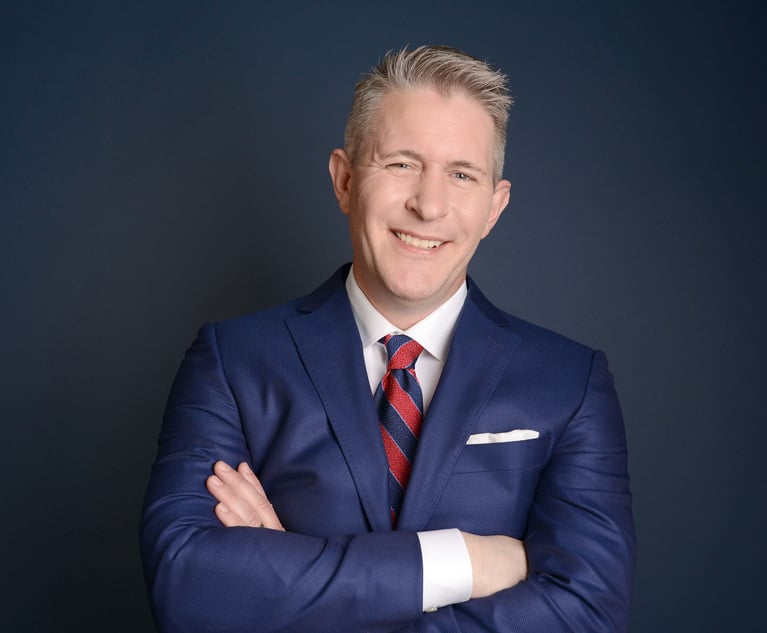
Arnold & Porter partner Christopher Rhee has seen his stock rise considerably in recent weeks.
As the presidential race bent hard in Barack Obama's favor, friends and acquaintances started calling and e-mailing Rhee -- who was an aide during the Clinton administration to then-Deputy Attorney General Eric Holder Jr.
"They want to know, ‘How do I get in the door, who do I talk to, can you put in a good word?'" Rhee says. "I think people are working whatever angles they can."
Rhee is particularly sought after, considering that his former boss is both a close adviser to President-elect Obama and a potential attorney general. The securities enforcement lawyer is one of dozens of former Clinton administration officials enjoying, or merely tolerating, renewed popularity as Obama assembles the legal arm of his administration. As the calls to Rhee suggest, Obama's legal team is starting to take on a decidedly Clinton-esque flavor. Four of the five members announced Friday as part of Obama's Justice Department transition team are Clinton administration veterans. And all of the top candidates mentioned regularly by D.C. insiders as potential AGs have Clinton administration ties.
At this point in the transition, however, names for key DOJ legal slots have yet to emerge. And Obama is facing new pressure from Capitol Hill to appoint an attorney general (or at the very least a deputy attorney general) with strong law enforcement credentials. That could favor a candidate with experience at Main Justice or in a U.S. Attorney's Office. And while many lawyers are maneuvering for any of the department's 400-odd political appointments, others have already been approached by Holder about serving in some of the department's top posts, according to people close to the transition.
Outside the DOJ, names are flowing more freely. New possibilities are surfacing for slots at the Securities and Exchange Commission, Federal Trade Commission and Federal Energy Regulatory Commission. And on the Hill, some senior legal staffers are eyeing slots in the Obama administration -- though bigger Democratic majorities may dampen some enthusiasm to leave the Hill. Senior aides are "just now getting to the most attractive part of the job -- being in charge," says Timmons & Co. Chairman Martin Paone, who worked for three decades as an aide to Senate Democrats.
NO GONZOS
With the memories of former Attorney General Alberto Gonzales and the widespread politicization of Justice still fresh in their minds, key members of Congress are weighing in on the credentials they want to see in the next AG.
In an op-ed published in Politico last month, Sen. Patrick Leahy, D-Vt., chairman of the Senate Judiciary Committee, and ranking member Sen. Arlen Specter, R-Pa., wrote that the next attorney general should "be someone with an overarching commitment to the law and to justice." That sentiment was followed by this one: "Both of us were prosecutors before we were elected to the Senate, and we understand that the rule of law and the principles of justice are larger than politics and should operate without partisanship."
The implied criterion is that the next attorney general should have chops as a federal prosecutor. At a panel discussion last week, Arnold & Porter's Robert Litt, a principal associate deputy attorney general under Clinton, put it more bluntly, saying that the next attorney general should be "strong and credentialed" in law enforcement and should have worked at Justice previously.
Of the names swirling around, few survive this standard. Holder, Wilmer Cutler Pickering Hale and Dorr's Jamie Gorelick, also a deputy attorney general during the Clinton administration, and Arizona Gov. Janet Napolitano, who was a state attorney general and a U.S. Attorney, would all still be in the running.
Holder, who has said he has no desire to return to government work, delivers a wealth of prosecutorial experience as a former Public Integrity Section lawyer, U.S. Attorney and No. 2 official at Justice. His involvement in the pardon of billionaire fugitive Marc Rich, a commodities trader who fled the country in 1983 to escape prosecution, would no doubt be revisited before the Senate Judiciary Committee, but he is admired by Republicans and Democrats alike.
Gorelick, who supported Sen. Hillary Clinton, D-N.Y., in the Democratic primaries, would bring a depth of experience in legal and national security affairs, having served on the 9/11 Commission and the CIA's National Security Committee, among others.
But her late support for Obama and her tenure as vice chairwoman of Fannie Mae, which ended just as the mortgage giant's accounting practices came under fire in 2003, could make her an awkward choice.
Napolitano, known for a strong law-and-order streak, was an early Obama supporter. She's a popular governor in her second term, and she was well-regarded during her six years as U.S. Attorney and four years as state attorney general. As a partner at Lewis and Roca in the 1990s, Napolitano represented Anita Hill during Clarence Thomas' nomination hearings to the Supreme Court. The memory still haunts some Republicans. And Napolitano, were she to become attorney general, would cede the last two years of her administration to Arizona's Republican secretary of state.
SHOULD I STAY OR SHOULD I GO?
On the Hill, Obama appears to be talking to former rival Hillary Clinton and may be considering Sen. John Kerry, D-Mass., for Cabinet-level appointments, according to several news accounts. But speculation about appointments has yet to penetrate far into the staff level. So far, only a few names have emerged among the lawyers: Phil Schiliro, longtime chief of staff to Rep. Henry Waxman, D-Calif., served as liaison between Obama's campaign and congressional Democrats and is advising the transition. Preet Bharara, the chief counsel to Sen. Chuck Schumer, D-N.Y., and a former prosecutor who drew accolades during the investigation into fired U.S. Attorneys, has been mentioned as a possible U.S. Attorney for the Southern District of New York.
More names could come quickly following congressional meetings this week and Obama's announcements of Cabinet secretaries over the next month. The House and Senate judiciary committees are considered obvious sources for administration lawyers, because they're often magnets for young talent. Other sources could be those committees, such as the Senate Foreign Relations Committee, that will see a change in leadership or the offices of legislators, such as Kerry and Clinton, who might be nominated to the Cabinet.
There's a tradition of members of Congress pushing key members of their staff into presidential administrations. Ron Klain, whom Vice President-elect Joe Biden chose as his chief of staff, served as chief counsel to the Senate Judiciary Committee in the late 1980s and early 1990s when Biden was chairman. When Bill Clinton became president, Klain became an associate White House counsel after a recommendation from Biden.
New administrations typically look to Congress for expertise anyway, because lawyers and other staff there have direct experience working with legislation. But, lawyers and lobbyists say, the demand for Hill staff could be even greater because the Obama transition team has restricted lobbyists' involvement. Some expect an exodus.
"The reality of Washington is that a good idea still needs a great advocacy plan to get enacted, and advocacy plans are created by and implemented by people who have a lot of experience in the legislative process," Holland & Knight partner Rich Gold says.
Eric Ueland, former chief of staff to then-Senate Majority Leader Bill Frist, says he expects many Democratic congressional staffers to jump at the chance to work for the Obama administration. "When you're staffing members or committees on the Hill, you build up expertise as well as attitudes and opinions about how a particular agency or program ought to be run," says Ueland, now vice president at the Duberstein Group. "Being able to take that into an administration is an empowering moment."
That's what happened in the last transition in late 2000, says Hazen Marshall, a former top aide to Senate Republicans. "We had people -- even within our leadership office at the time -- who moved over to the administration, and I think that's something that Democrats on the Hill are going to lament, that a lot of their senior staff are going to disappear," says Marshall, now with the Nickles Group.
Still, Timmons & Co.'s Paone says the Hill may remain attractive for Democratic staffers. Though Democrats have been in charge for two years in Congress, their margin has been close and they've worked under the threat of a presidential veto. The new session, he says, will offer them their first chance to accomplish major legislative projects, making it more difficult to lure staffers away.
Then there are the longer hours and greater scrutiny that an administration can bring, current and former congressional staff members say. Moving from Congress to the Obama administration will likely be most attractive to young staff members who eventually want experience in both worlds, says Joel Jankowsky, a partner at Akin Gump Strauss Hauer & Feld. "The excitement of a new administration is enticing to youngsters who might have been up there for only a Congress or so," Jankowsky says.
MORE NAMES
At the agency level, D.C. continued to buzz with potential names for top legal slots.
At the Securities and Exchange Commission, some new names popped up for the top post. They are: Richard Ketchum, the CEO and director of the New York Stock Exchange, William McLucas, chairman of the securities department at Wilmer Cutler Pickering Hale and Dorr, and Robert Pozen of MFS Investment Management. Pozen, according to securities lawyers, is considered a leading contender. Pozen declined to comment.
With Obama likely focused on the struggling economy, antitrust lawyers realize the job that concerns their clients the most -- the chairmanship of the Federal Trade Commission -- may take longer to be announced. Two more names were added to that list as well. They are: Leslie Overton, a partner at Jones Day, and Christine Varney, a partner at Hogan & Hartson. Overton worked at the DOJ's Antitrust Division in 2002 until 2004 as counsel to the assistant attorney general. Varney, who heads Hogan's Internet practice group, served as a commissioner with the FTC from 1994 until 1997.
Both lawyers have strong connections to Obama. Overton's husband, Spencer, a law professor at George Washington University, helped raise more than $500,000 for the president-elect, and Varney is on sabbatical with Obama's transition team. (Overton declined to comment, and Varney did not return calls or e-mails seeking comment.)
While names of potential Obama picks for many agencies are plentiful, lawyers had trouble coming up with potential leaders of the Federal Energy Regulatory Commission.
D.C. energy lawyers say Susan Tierney, a consultant with the Analysis Group in Boston, could be one, given her experience as commissioner for the Massachusetts Department of Public Utilities. J.A. Bouknight, head of Steptoe & Johnson's electric power practice, offered two other names: Suedeen Kelly and Jon Wellinghoff. Both are currently commissioners at FERC. Wellinghoff is from Nevada, like Senate Majority Leader Harry Reid. Bouknight says Wellinghoff's ties to the Democratic leader could help when it comes time to name the agency's new chairman.