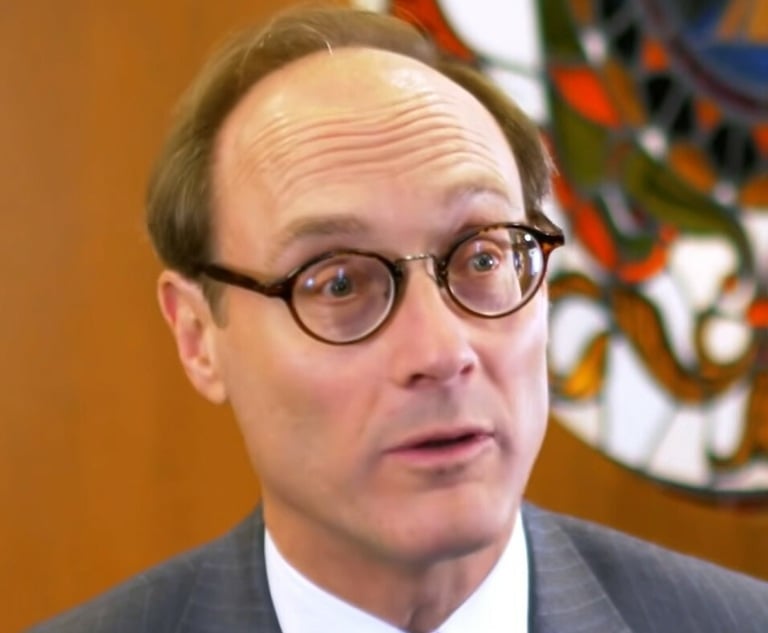
Six years ago, Theodore Metzler launched one of the first Supreme Court blogs with predictions of how pending cases would turn out.
He did not do well, bested by another blogger who was handicapping the docket a little better.
On Oct. 14, Metzler, now an associate at Covington & Burling, stood before the justices to argue his first case. His blogging long behind him, Metzler knows better than to guess how his own case, Pearson v. Callahan, will turn out.
"I lost the handicapping contest, so I'm probably better off not making any predictions," says Metzler, 39.
Predicting that Metzler would have been arguing the case in the first place would have been just as tough. With law firm partners on the one hand and Supreme Court legal clinics on the other competing intensely for cases to argue, an associate like Metzler might have to wait in a long line. It is still rare -- though not as rare as it was a decade ago -- for a nonpartner to argue a Supreme Court case. At Covington, it hasn't happened for more than 20 years.
And representation of criminal defendants like convicted drug dealer Afton Callahan is being handled more and more by law school-affiliated clinics, assuming the original lawyer agrees to share the glory.
Metzler argued for Callahan in a difficult police "qualified immunity" case with Fourth Amendment ramifications. The issue was whether allowing a police informant into one's house amounts to "consent-once-removed" that permits police to come in later without search warrants.
Metzler snagged the case by using techniques he first learned about straight out of Georgetown University Law Center, working as a clerk for Thomas Goldstein, now with Akin Gump Strauss Hauer & Feld. "That gave me the bug," Metzler says. Goldstein saw cases coming early, and contacted lawyers before they got to the Court. Metzler saw that Callahan won at the circuit level. Guessing that the police officers would appeal, Metzler contacted Callahan's original lawyer, James Slavens of Fillmore, Utah.
The police did petition the high court, and the name of Covington's appellate chief, Robert Long Jr., joined Slavens' on the brief opposing review. When the Supreme Court accepted the case, Slavens says, "I got lots of calls" from clinics and other lawyers offering aid, even though Covington was already on board.
At this point, the senior partner would usually tell the eager associate to step aside, but Long did not do that. “We've worked together on several pro bono cases and he's done superb work," Long says.
Not bad for a second career. Metzler was a web designer and Internet consultant, switching gears to to go into law just before the dot com bubble burst.
By all accounts, Metzler held his own arguing before the justices, surviving something of a rookie hazing from Chief Justice John Roberts Jr. Roberts asked him at one point why the Court had to decide the difficult constitutional question in the case before resolving the easier issue of whether the police should be immune from lawsuits over the raid.
"With respect, Mr. Chief Justice, I don't think it's a difficult question," Metzler replied.
"Well, I know you don't because you are arguing one side of it," Roberts replied. The two then had a lengthy dialogue about the issue that seemed to mollify, if not convince, Roberts.
At one moment during the argument, Metzler says he suddenly realized that "I was actually having a conversation with the justices." His years of studying, blogging, and learning about the Court were coming together. Metzler allows himself a prediction: "I expect to argue there again."