An attorney who quit her job after returning from maternity leave is suing her former law firm for allegedly cutting her salary while she was pregnant and for creating a "hostile environment."
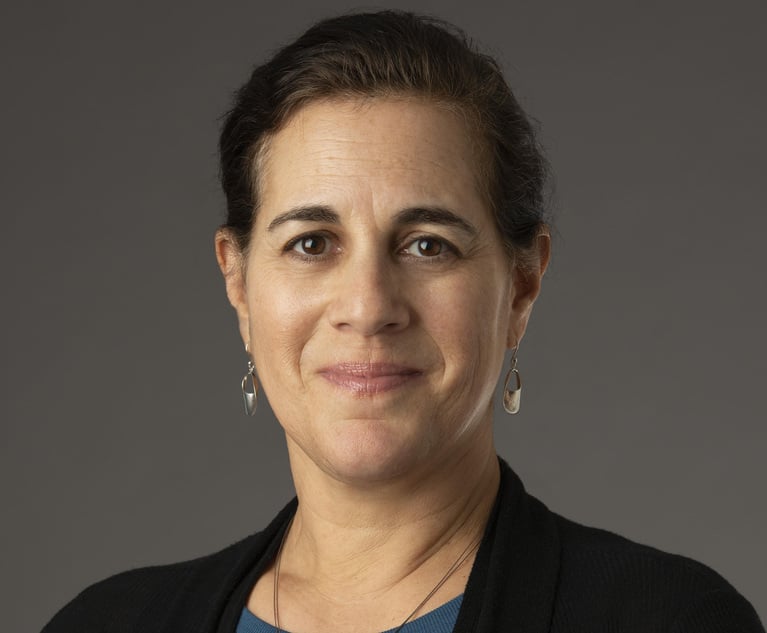
Jacquelyn Todaro, a former associate at Siegel Fenchel & Peddy, a tax certiorari boutique in Garden City, N.Y., claims she was discriminated against by the firm's principals because she is a woman who became pregnant.
Maria H. Moscarelli, a former legal assistant at the firm, is also suing on the same grounds.
The federal trial in Todaro v. Siegel Fenchel & Peddy, CV-04-2939, began Monday before Eastern District of New York Judge Joanna Seybert in Central Islip, N.Y.
In his opening statement, Steven I. Locke of Carabba Locke in Manhattan described his clients as "two working moms" who consistently received praise and salary increases until they became pregnant or took maternity leave.
Shortly after notifying the partnership that she was pregnant in November 2002, Todaro's salary was cut to $76,875 a year from $102,500, Locke told the jury of four men and four women.
"There were no prior warnings as described in the firm's own employment policies," Locke said. "Being five-months pregnant [Todaro] began looking immediately [for a job] as she was the primary breadwinner. ... Her first obligation was to her firstborn child."
On the witness stand, however, Todaro acknowledged she did not notify or discuss her desire to leave the firm with any of the name partners -- William D. Siegel, Saul R. Fenchel and Tracie P. Peddy. Siegel writes a tax certiorari and condemnation column for the New York Law Journal.
Todaro admitted writing a memo to Fenchel around February 2003 about how her pending cases would be handled during her maternity leave and gave an approximate return date.
When asked by Locke why she indicated she would be returning to the firm when, in fact, she had made plans to leave, Todaro testified that she felt she was being forced out.
"My salary cut was a clear indication that they no longer wanted me there," she said.
After graduating from Hofstra Law School, Todaro took a job in August 1996 as a temporary legal secretary at Siegel Fenchel. She was subsequently hired as a full-time law clerk and was made an associate that November. She left the firm in July 2003, upon her immediate return from maternity leave.
Todaro testified that she received annual pay increases every year until 2003, and had never received a negative performance appraisal or any indication her work was lacking.
But she said that during the same period a male associate was given prime job assignments and made more money than she did despite his incompetence.
As examples, Todaro testified that she was asked by a partner to replace the male associate in drafting an article for the Law Journal and she pointed to an instance where a partner had done all the preparation for the associate to handle an upcoming trial because of a "tacit understanding that [the associate] was unable to perform."
In his opening statement, Kevin M. Fox of Hauppauge, N.Y., who represents the law firm, portrayed the partnership, which had about 12 attorneys at the time Todaro was there, as a woman-friendly environment where female associates were promoted and given every opportunity to succeed.
Of the six associates who worked at the firm during the relevant period, four were women and two were men, according to court records. The office manager was also a woman, in addition to Peddy, a name partner.
To increase the associates' networking opportunities, Fenchel bought each a set of $2,000 golf clubs and paid for lessons, Fox told the jury. The lawyer also said Fenchel had written Todaro a personal check for $10,000 for her wedding and had paid off her $4,000 car lease. Todaro confirmed both events on the stand.
Fox told the jury that cutting salaries was well within the firm's right, as raises were based on merit and given at management's discretion. By 2003, he said, Todaro's work ethic had declined and her work product "was going downhill."
For example, Fox said, when asked why a batch of cases were lingering with no settlements, Todaro told the partnership, "'Well those cases are crap and that's why I'm not working on them.'"
On the stand, Todaro attempted to clarify her remarks by explaining that certain municipalities took longer to settle cases.
"When I said that the cases were crap, what that meant was ... I determined whether or not those cases had merit -- the cases that didn't have merit, you didn't negotiate those cases," she said.
Moscarelli, who joined Siegel Fenchel in 1987, also claimed she received salary increases and no negative reviews until she was terminated shortly after returning to the firm in August 2003 from maternity leave.
Siegel Fenchel & Peddy merged with Koeppel Martone & Leistman, a Mineola, N.Y., tax firm, earlier this year.
The women are seeking $15 million in compensation. The trial is expected to last seven days.