Alan Gura.
Credit: Diego M. Radzinschi/Legal Times
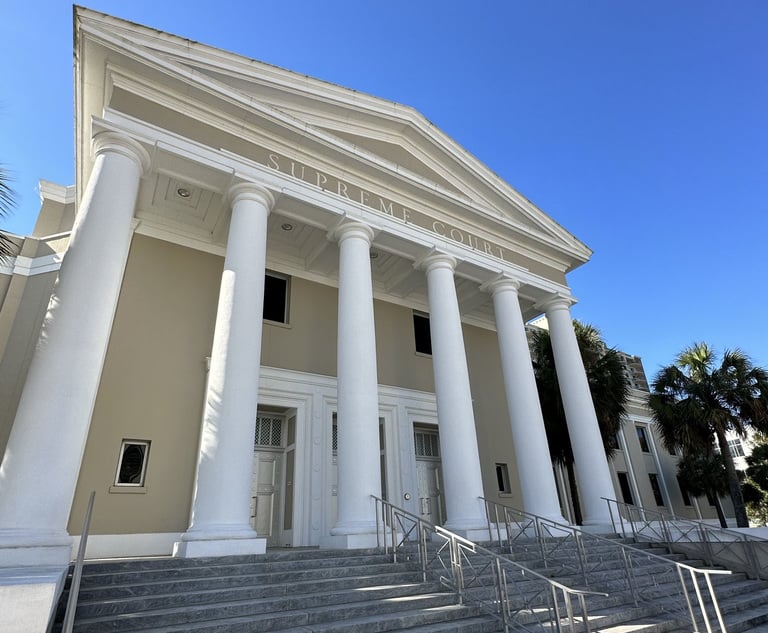
A group of gun rights advocates roared with approval as Alan Gura descended the stairs of the Supreme Court on the morning of June 26, having just learned of the high court's decision in the landmark Second Amendment case, District of Columbia v. Heller.
"Goodbye, gun ban!" they chanted. Gura, whom history will remember as the lawyer who successfully argued that Americans have an individual right to keep and bear arms, smiled broadly. Goodbye, gun ban.
Sixteen-year-old Tommy Estopare had negotiated around a clump of reporters and photographers to get up next to Gura. The high school student from Imperial, Mo., came away with his autograph. "I don't think I agree with most of the things he says, but he's a great lawyer," Estopare explained.
A few minutes later, Mary Mitchell Purvis, a senior at the University of Mississippi, caught Gura between interviews with Associated Press Television News and National Public Radio. She presented the 37-year-old lawyer with a copy of the Heller opinion. "Would you sign this? I'm doing my thesis on your case." But of course he would.
When libertarian activist Robert Levy, the lawsuit's financier, tapped Gura to argue the case before the Supreme Court earlier this year, more than a few Court watchers questioned the young lawyer's qualifications. Though he won the case in the U.S. Court of Appeals for the D.C. Circuit -- in his first federal appellate arguments -- it was presumed that the high court work would go to a veteran.
And now here was Gura, with his shaggy brown hair and iPhone, signing opinions like they just went gold.
Once he and his co-counsel had finished the stakeout interviews, Gura and Levy caught a ride to the Cato Institute on Massachusetts Avenue Northwest in Washington, D.C.
Gura sat in his borrowed cubicle at Cato -- he has a K Street office, but he wanted convenient access to Capitol Hill, in case he was called for an interview -- alternately consulting the Internet and his phone, which, by noon, was laden with hundreds of voicemails, e-mails and text messages.
He laughed easily when reminded of the doubt that had surrounded Levy's decision to place him before the high court.
"Lawyers far more esteemed than I have had cases stolen from them," said Gura. "I don't think it's possible to have an important legal case in Washington without someone else trying to snatch it away."
A call interrupted him. It was his wife, Amy: "Yeah, it's huge!" he told her. "It's really a profound ruling. We'll talk more about it when I get home. Muah."
The District's solicitor general, Todd Kim, phoned in his congratulations, too. Then a stream of interviews with reporters: "It's a victory for all Americans ... the Court did its duty ... the government cannot ban guns or regulate them out of existence ... No, I wouldn't wish indigestion on Mayor Bloomberg ... Mayor Fenty needs to start acting like this affects him, because it does."
In the gaps between calls, Gura scanned the blogs for news of his victory: Volokh Conspiracy, Of Arms & the Law, Drudge Report (which bore a picture of a revolutionary holding a musket, with the caption, "Carry On") and SCOTUSblog.
"Come here. Look at this," he said, pointing to a blog post by Alan Morrison, the veteran Supreme Court advocate who, until his dismissal from the D.C. Attorney General's Office in January, was slated to defend the city's handgun ban before the high court.
Gura had highlighted an excerpt of Morrison's quick analysis of the ruling on SCOTUSblog: "Bottom line: looks like a full-employment decision for lots of gun lawyers and state, federal, and municipal attorneys -- but not including me."
Well, it's true, isn't it? "Yeah, I expect it will lead to a few other things that are gun-related," Gura said, referring to his D.C.-based two-lawyer civil litigation firm, Gura & Possessky.
He hadn't even read the Heller opinion in its entirety on Thursday, when Gura and a friend from his days at Georgetown University Law Center, David Sigale, filed a lawsuit in the U.S. District Court for the Northern District of Illinois, seeking to strike down Chicago's gun ban. The Second Amendment Foundation is bankrolling the litigation.
"OK. This win will definitely open up some avenues," Gura said later, in the green room at CNN's Washington bureau. The network had sent a car to pick him up for an interview with Glen Beck at 3:15 p.m.
A television to his right displayed an interview with Sen. Barack Obama, D-Ill., who responded to the decision with a vague nod to both an individual right to bear arms and the government's right to regulate it. Sen. John McCain, R-Ariz., praised all four corners of the opinion.
"To be honest, I don't really like either of them," Gura volunteered.
His choice for president: Libertarian Bob Barr.
Gura, a Los Angeles native, has been a student of the Second Amendment since Heller was filed in 2002. He wrote all of the pleadings in consultation with Levy and Clark Neily III, a senior staff attorney at the Institute for Justice. Gura's familiarity with the contours of the case and the depth of his knowledge of gun laws, generally, convinced Levy that he was the strongest candidate to argue the case before the Supreme Court.
Gura says that he's not opposed to being typecast as "the gun guy," but calls it a misnomer. (Yes, he keeps firearms in his home in Alexandria, Va., but Gura refuses to describe his stock, except to say, with no small amount of self-satisfaction, that "they are legal under the Constitution.") Most of the angry mail he's received while working on Heller has come from gun rights advocates who say he "sold out the Second Amendment" by conceding that some regulation was necessary.
While Gura thinks the District's ban on semiautomatic weapons is unconstitutional -- the law remains in effect -- he said he wouldn't file a lawsuit seeking Second Amendment protection for automatic weapons: "Let someone else do it."