Incisive Media's Law.com
  • Law.com Network
  • Legal Web
Register for Law.com Newswire
Newsletters
RSS

Law.com Home > Federal Judge Responds to Limerick Brawl With a Bit of Poetic Justice

Font Size: increase font decrease font

Federal Judge Responds to Limerick Brawl With a Bit of Poetic Justice

Shannon P. Duffy

The Legal Intelligencer

June 25, 2008

  • deliciousdel.icio.us
  • digg Digg
  • redditReddit
  • facebookFacebook
  • googleGoogle Bookmarks
  • newsvineNewsvine
  • linkedinLinkedIn
  • mixxMixx
  • stumbleuponStumbleupon
  • Print
  • Share
  • Email
  • Reprints & Permissions
  • Write to the Editor

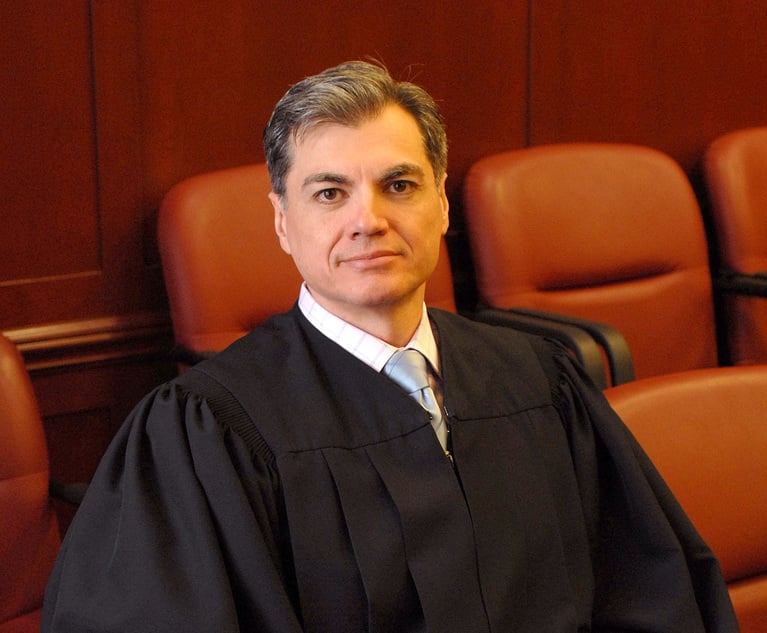
When U.S. District Judge Berle M. Schiller decided to dismiss a claim brought by Limerick Golf Club Inc., the judge apparently couldn't resist the temptation to end his opinion with a poem.

To appreciate the limerick, one needs to know a little about the case.

Daniel Sullivan sued Limerick Golf Club over a barroom brawl, claiming he was assaulted in the club's Sandtrap Sports Pub by another patron who was allegedly served more alcohol after he was visibly intoxicated.

The club filed an answer to the suit in February 2007 and five months later filed a third-party complaint against the alleged assailant, Peter Contastathes, seeking to implead Contastathes as a joint tortfeasor.

But Contastathes' lawyer moved to dismiss the third-party complaint, arguing that the club's lawyers had violated Rule 14 of the Federal Rules of Civil Procedure by failing to obtain court permission to file a third-party complaint more than 10 days after filing its answer.

Schiller agreed, saying: "Unfortunately for Limerick, their sub-par performance occurred in the pleading stage of this case and not on the golf course."

The judge then succinctly summarized his holding in a poem:

With arguments hard to resist,
The movant correctly insists,
His joinder was tardy,
And so the third-party
Complaint is hereby dismissed.

Schiller also rejected the club's argument that its delay was justified because Contastathes was improperly identified in the original complaint as "Peter Constakes."

"Limerick has failed to show that it could not have ascertained Contastathes's identity with 'reasonable diligence' within the 90-day period specified by the local rules," Schiller wrote.

According to court papers, plaintiff Sullivan is a police officer from Frederick, Md., who attended an Ursinus College alumni event at the Limerick Golf Club in October 2004 and later joined a group of four other alumni for dinner in the club's restaurant.

The suit says Sullivan wasn't drinking any alcohol, and that while dining, he witnessed a scuffle between a man and woman and watched as the bleeding man was escorted out of the club by security.

But the suit alleges that soon after, the man, later identified as Contastathes, was permitted to return despite the fact that he was "known to the proprietors and staff of The Sandtrap Sports Pub as having a reputation for violence."

The suit says Contastathes then resumed the argument with his girlfriend, and that the couple left through glass emergency doors near Sullivan's table.

Sullivan claims the girlfriend later returned to the emergency doors, which had locked behind her, and motioned for Sullivan to allow her in, but that Sullivan declined because he didn't want to get involved.

The girlfriend, who is identified in court papers only as "Lisa," then returned through the main doors, the suit says, and angrily confronted Sullivan at his table, yelling obscenities and throwing a drink in his face.

The suit alleges that the club's security staff "did nothing to control the situation," and that while Sullivan and Lisa were exchanging words, Contastathes approached and punched Sullivan in the head from behind.

At that point, the suit alleges, two security guards pulled Sullivan and Contastathes apart and held Sullivan face down on the ground while not restraining Contastathes at all "despite his known propensity for violence and the fact that he had been loud, boisterous, fighting and escorted from the bar during the preceding 15 minutes."

While the guards were holding Sullivan on the ground, the suit alleges, Contastathes kicked Sullivan in the face, causing significant injuries including "closed head injury; severe damage and displacement of multiple teeth; severe lacerations of his face and lip; significant blood loss; facial scarring; deformity; [and] significant physical and emotional pain and suffering."

In the suit, Sullivan's lawyer, Thomas A. Lynam III of Villari Lentz & Lynam, accused Limerick Golf Club of violating the Dram Shop Act by serving alcohol to a visibly intoxicated person and negligence for failing to provide adequate security.

The club's lawyer, John Reed Evans of Bolan Jahnsen Reardon in Havertown, Pa., denied the allegations in an answer to the suit and later filed a third-party complaint against Contastathes.

But Contastathes' lawyer, Patrick Kurtas of Prince & Kurtas in Pottstown, Pa., moved to dismiss the third-party complaint on numerous grounds.

By filing the third-party complaint five months after it filed its answer and without first getting court permission to do so, Kurtas argued, the club violated Rule 14 of the Federal Rules of Civil Procedure.

Kurtas also argued that his client couldn't possibly be a joint tortfeasor with the club under the Dram Shop Act or the negligent security claim. Instead, he argued, the only potentially valid claim against Contastathes would be for negligence and the statute of limitations had already run on that claim.

Now Schiller has sided with Kurtas, finding that Rule 14 includes "mandatory language" that calls for defendants to file a motion for leave to file a third-party complaint if doing so more than 10 days after an answer is filed.

"Limerick's failure to make the required motion alone justifies striking its third-party complaint," Schiller wrote.

Schiller also found that the complaint was "unjustifiably untimely" because the Eastern District of Pennsylvania's Local Rule 14.1 says that such leave should ordinarily be denied if the request comes more than 90 days after the answer, and Limerick Golf Club waited five months.

Under the local rule, Schiller said, an exception may be made only if the court is satisfied that the identity of the party sought to be joined or the basis for joinder "could not with reasonable diligence have been ascertained within said time period."

The burden was on Limerick to prove its diligence, Schiller said, and it failed to do so.

"Limerick must have been aware of Contastathes's existence and role in the case as of February 2007 at the latest," Schiller wrote. "... Nor is Limerick's delay and improper filing cured by its assertion that Contastathes was 'difficult to track down' because his name was misspelled in the plaintiff's complaint and he had left the state."

Even if those facts were accepted, Schiller said, Limerick failed to show that it was unable to identify Contastathes within 90 days.

Evans declined to comment on the ruling.

Kurtas said in an interview that he was pleased with the ruling and is considering filing a motion for sanctions because the third-party complaint not only violated Rule 14, but was also baseless and untimely.

Lynam could not be reached for comment.


Subscribe to The Legal Intelligencer

  • Print
  • Share
  • Email
  • Reprints & Permissions
  • Write to the Editor

Related Items

  • Adverse to Verse
  • Pa. Court Denies Appeal in Dog-Inspired Doggerel

Advertisement

Top Stories From Law.com

Legal Technology

  • Public Performance in the Digital Age

Corporate Counsel

  • United Technologies Takes a Stand, Puts Billable Hour 'on Life Support'

Small Firm Business

  • Holiday Parties: Keeping Expenses Low and Deductibility High

Advertisement

lawjobs.com

TOP JOBS

MORE JOBS >>

POST A JOB >>

Advertisement

About ALM  |  About Law.com  |  Customer Support  |  Reprints  |  Privacy Policy  |  Terms & Conditions
Close [ X ]