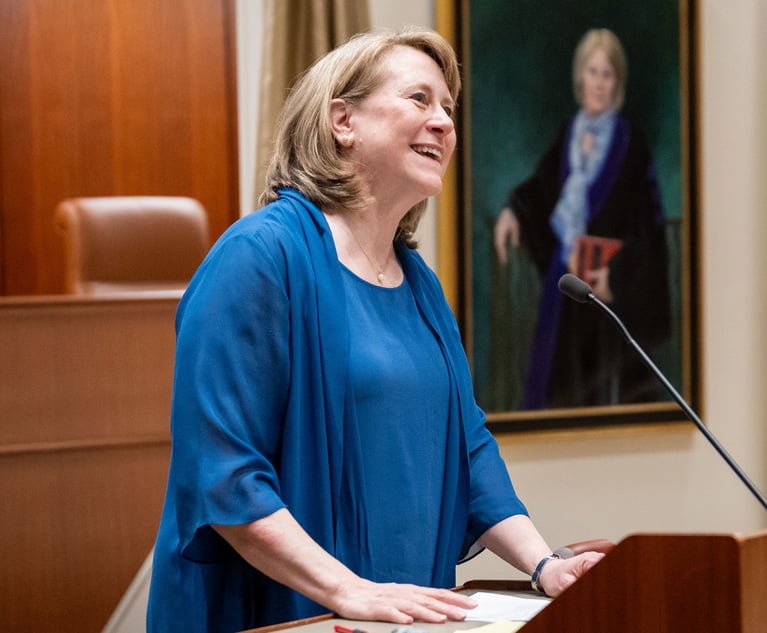
Crowell's Stuart Newberger
image: Patrice Gilbert/Legal Times
When Mansur Maqsudi divorced the daughter of Uzbek dictator Islam Karimov, Maqsudi bought himself a load of trouble -- and his lawyer found himself in a bind. Maqsudi is an American of Afghan-Uzbek extraction who, in partnership with The Coca-Cola Co., formerly operated a lucrative bottling plant in Uzbekistan through his family firm, ROZ Trading Ltd. In 1991 Maqsudi married Gulnora Karimova, the Harvard-educated daughter of President Karimov of Uzbekistan, a nation that is ranked by the nonprofit Freedom House as one of the eight "Worst of the Worst" human rights offenders, alongside Sudan and North Korea.
This proved to be a good career move only in the short term. After the marriage collapsed in 2001, Maqsudi says, his family in Uzbekistan was deposited on the Afghan border, while his children were spirited from New Jersey to Tashkent, the Uzbeki capital. He also claims that Uzbekistan effectively seized his share of the bottling business and transferred control to a Swiss company in which his ex-wife has a significant interest. Coca-Cola, according to Maqsudi, went along for fear of angering the Karimov clan. Both Coca-Cola and Karimova deny Maqsudi's allegations.
The lawyer whom Maqsudi retained to recover his investment -- Stuart Newberger of Crowell & Moring -- had no obvious course of action. He could not sue Uzbekistan directly, because the nation had never signed an investment treaty with the United States. He could sue Coca-Cola for conniving in the vendetta, under the arbitration agreement signed by the members of the bottling joint venture -- but it would be tough to implicate Coke without a broad U.S.-style discovery expedition. Newberger found an explosive solution in a quiet nook of federal procedure, 28 U.S.C. 1782. [See "A Question of Autonomy."]
Seldom used for 40 years, §1782 allows discovery in the U.S. courts in aid of a foreign "tribunal." In the 2004 case of Intel Corp. v. Advanced Micro Devices, Inc., which arose out of a European antitrust complaint by the chip maker AMD against its rival Intel, the U.S. Supreme Court ruled that the European Commission qualifies as a tribunal because it serves a "quasi-judicial" function. A footnote suggested that the same logic might apply to an arbitral tribunal, despite rulings to the contrary in the U.S. Court of Appeals for the 2nd and 5th Circuits.
In October 2006 a New Jersey federal district court extended the Intel ruling to investment arbitration, in another case that, oddly enough, also stemmed from Central Asian crony capitalism. Oxus Gold plc v. Kyrgyz Republic was a classic state-investor dispute. A U.K.-based mining company, Oxus claimed that Kyrgyzstan effectively seized its interest in a local gold mine and gave it to Austria-based Global Gold Holding GmbH.
To help prove its allegations, Oxus successfully invoked §1782 in the U.S. courts to obtain discovery from a New Jersey-based consultant for Global Gold. No appeal was pressed on the discovery issue. The Oxus arbitration recently settled on confidential terms, after an ad hoc panel asserted jurisdiction over the claim under the Anglo-Kyrgyz investment treaty.
Fast on the heels of Oxus, in the case of Coke in Uzbekistan, Newberger made a sweeping argument that the Intel view of §1782 should extend even to private commercial arbitration. An Atlanta federal district court judge embraced his argument in December 2006, over the objections of Coke's counsel from King & Spalding. Coca-Cola agreed to cough up thousands of internal e-mails -- and Newberger introduced the e-mail in the main arbitration in Vienna, which continues. Score one for the jilted husband with the creative attorney.
"This case has really required a blend of arbitration and litigation," says Newberger. "It shows that, in solving problems for clients in the international business world, you have to bring those skill sets together. That's what's so interesting about §1782."
Arbitration commentators tend to find §1782 more worrisome than interesting. David W. Rivkin of Debevoise & Plimpton, a lead author of the International Bar Association (IBA) rules of evidence in international arbitration, objects to the heavy-handed intrusion of domestic courts into the gentler process that arbitration parties have opted into. The IBA rules of evidence, which have been widely followed, aim to split the difference between the civil and common law approaches. They allow documents to be requested only by narrow specific categories, provided that they are relevant and material.
"Electronic discovery [in arbitration] would be a nightmare," says arbitration specialist Jay Alexander of Baker Botts. "That's why I quit litigation in the first place."
What one thinks of arbitral discovery may boil down to one's view of U.S. courts. After all, U.S. judges have discretion to reject abusive requests. "The Supreme Court has basically said, 'We're prepared to export our discovery rules,' " maintains Clifford Chance's Jon Roellke, who represents Oxus. "The Supreme Court is completely comfortable with the role U.S. district courts will play."
Whether non-Americans are comfortable is another matter. Discomfort with judges is the raison d'être of international arbitration; and most Europeans would rather chew thumbtacks than submit to U.S. court discovery. At the same time, §1782 generally places foreigners at an advantage, because U.S. parties are more easily reached by U.S. discovery.
Whatever the wisdom of its new interpretation, §1782 is a powerful tactic, and it is expected to be deployed frequently. Curiously, it has only been invoked once in a written decision since the Uzbek case, in a Minneapolis district court. Roellke speculates that discovery requests are simply being granted without dispute. "After the Supreme Court's Intel decision, everybody was waiting for a case like this to come along," he says. "Once that shoe dropped, I think it's been generally accepted."
Not so fast. In April 2008 Coca-Cola obtained a final order from the Atlanta federal court and filed an appeal to the 11th Circuit. "The Coca-Cola Company did not settle the discovery dispute with Roz Trading, although it did comply with the terms of the district court's order on discovery," states Joseph Loveland of King & Spalding, who declined to discuss the matter further. Meanwhile, briefs discussing the spilled e-mails have already been filed with the Vienna arbitrators, who plan to hear the the merits in September. "If ever something was moot, this is moot," argues Newberger.
Rivkin, for one, believes that the new aggressive rule on discovery is vulnerable on appeal. There's a big difference, he says, between discovery aiding the public proceedings of the European Commission -- which the Supreme Court blessed in Intel -- and discovery in aid of arbitration, especially private commercial arbitration. Rivkin believes that this appellate issue will eventually percolate up to the Supreme Court, and its position is by no means obvious. "You have to think that footnote [in Intel regarding arbitration] was stuck in by some bright young clerk, and nobody really focused on it," he says.
A lot of arbitration lawyers have been waiting eagerly for §1782 to be clarified. They're just grateful that one foreign investor was bold enough to divorce the Uzbek dictator's daughter.